The claim-by-claim source ledger behind Data Goblin: every factual statement in the guide, matched to the receipt that backs it up.
#1 Cohere Series D lead investor (resolved)
Link to this receipt · Français
✅ PSP Investments led the July 2024 $500M round at $5.5B (not CPPIB, not December). Subsequent raise ~$6.8B. All CPPIB references corrected. | BetaKit, Crunchbase News, PSP Investments
#2 Council of Europe AI Framework Convention (resolved)
Link to this receipt · Français
✅ Canada SIGNED February 11, 2025 (Paris AI Action Summit). Manuscript's "Canada has not signed" finding was wrong — replaced everywhere with "signed but not ratified." Confirm ratification status at publication. | Canada.ca, CoE
#3 Voluntary Code of Conduct signatories (resolved)
Link to this receipt · Français
✅ CGI + IBM joined Dec 2023; Mastercard + Salesforce May 2024 — later waves, not originals. Microsoft had not signed as of June 2026. List corrected in 4 locations. Full current list (46 orgs, incl. Amii/Mila/Vector; Microsoft + Waabi absent) captured 2026-06-09 → Sources/ised-voluntary-code-signatories-2026-06.md. | Canada.ca Dec 2023, Canada.ca May 2024, ISED Code page
#4 Denmark likeness-rights law (resolved)
Link to this receipt · Français
✅ 2025 proposal, not 2024 law: consultation July 2025, TRIS notification Oct 2025, vote expected Q1/Q2 2026. Includes satire/parody/criticism-of-power exceptions + 50-yr post-mortem protection. All "2024 legislation" references corrected; confirm enactment at publication. | Plesner, WEF
#51 Canadian CPTC (resolved)
Link to this receipt · Français
✅ Federal Canadian Film or Video Production Tax Credit is a fully refundable tax credit at 25% of qualified labour expenditure, intended to encourage Canadian film/TV programming and an active domestic independent production sector. | Canadian Heritage CPTC
#52 Federal PSTC (resolved)
Link to this receipt · Français
✅ Federal Film or Video Production Services Tax Credit is 16% of qualified Canadian labour expenditures, available to eligible production corporations including foreign-owned corporations, designed to enhance Canada as a production location and secure investment. | Canadian Heritage PSTC
#53 B.C. production-services tax credit (resolved)
Link to this receipt · Français
✅ B.C. production-services credit is available to domestic and foreign producers with no Canadian content requirement; B.C. lists the basic production-services rate at 36% plus regional, distant-location, DAVE, and major-production credits. | Province of B.C. PSTC
#54 CRTC Online Streaming Act contribution framework (resolved)
Link to this receipt · Français
✅ CRTC 2026-96 says the Online Streaming Act requires modernization of the Canadian broadcasting framework and meaningful contributions from online streaming services to Canadian and Indigenous content; it sets a modernized Canadian programming expenditure framework, including large ownership-group contribution requirements. | CRTC 2026-96
#55 Canadian film/TV production-volume shock and partial rebound (resolved)
Link to this receipt · Français
✅ CMPA/Profile 2024 documented total production volume down 18.5% to $9.58B in 2023/24; CMPA's Profile 2025 release says the sector generated $10.2B in 2024/25, a 4.6% year-over-year increase. | Profile 2024 PDF, CMPA Profile 2025 release
#56 Erica Lapadat Janzen BC + AI talk (resolved)
Link to this receipt · Français
✅ Public BC + AI video page documents Erica Lapadat Janzen's "Soft Violence in AI Art Discourse" Vancouver AI meetup talk; transcript reviewed from attached source. | BC + AI video page, YouTube
#57 GPT-3 scale (Ch. 2 Goblin Fact) (resolved)
Link to this receipt · Français
✅ CONFIRMED. GPT-3 (Brown et al., 2020) is 175 billion parameters across 96 transformer layers, trained on ~500B tokens. Added as a Ch. 2 Goblin Fact (2026-06-16) to make the manuscript's existing "hundred billion parameters" wording exact. Primary source is the NeurIPS paper. | NeurIPS 2020 PDF
#58 Gender Shades error gap (Ch. 15 Goblin Fact) (resolved)
Link to this receipt · Français
✅ CONFIRMED. Buolamwini & Gebru, "Gender Shades" (PMLR 2018): commercial gender-classification systems misclassified darker-skinned women up to 34.7% of the time vs 0.8% for lighter-skinned men (IBM, Microsoft, Face++). Added as a Ch. 14 Goblin Fact (2026-06-16) to make the manuscript's existing "more than ten times higher" wording exact; pairs with the adjacent Goblin Check on averages. | PMLR v81, MIT News
#6 "DGC President Warren Forget" (fixed)
Link to this receipt · Français
DGC National Executive Director Dave Forget (name was fused with President Warren Sonoda) — confirm against INDU committee evidence, Feb 2024 | Ch. 11, appendix
#7 "Mason v. Canada (2019)" (likely confabulated) (fixed)
Link to this receipt · Français
***Ewert v. Canada (2018 SCC 30)* — actuarial risk tools never validated for Indigenous offenders; the real leading case | Ch. 13, appendix ×2
#8 "Ontario… does not have an independent privacy commissioner" (fixed)
Link to this receipt · Français
Ontario's IPC is real and independent; the actual gap is no provincial private-sector privacy law | Ch. 16
#9 "CWA-CEP" (defunct since 2013) (fixed)
Link to this receipt · Français
Unifor + CWA Canada | Ch. 14
#10 EU AI Act fines "6% / €30M" (draft figures) (fixed)
Link to this receipt · Français
7% / €35M for prohibited practices | ×4
#11 TAKE IT DOWN Act "passed 2024" (fixed)
Link to this receipt · Français
Signed into law May 2025 | Ch. 12, appendix
#12 Australia "two-year imprisonment" (fixed)
Link to this receipt · Français
Up to 6 years (7 aggravated), 2024 federal amendments | Ch. 12, Ch. 15
#13 "EED Directive 2024/1364" (fixed)
Link to this receipt · Français
Recast EED is 2023/1791; 2024/1364 is the delegated regulation — relabelled everywhere | ×6
#14 NVIDIA "3.7M GPUs in 2024" (fixed)
Link to this receipt · Français
Est. 3.76M data-centre GPUs in 2023 (TechInsights) — confirm latest figures | ×3
#17 "January 2025 AI Action Plan" (fixed)
Link to this receipt · Français
Jan 2025 executive order; Action Plan July 2025 | Ch. 15
#18 California AB 730 cited as current (fixed)
Link to this receipt · Français
AB 2839 (2024), AB 730 sunset | ×3
#19 OCAP 25th anniversary "2024" (fixed)
Link to this receipt · Français
2023 (OCAP est. 1998) | Ch. 9
#20 NYT v. OpenAI "settled in 2026 via NYT–Amazon" (fixed)
Link to this receipt · Français
Amazon deal = licensing (2025), did not settle the case; appendix now matches Ch. 11 ("active") — confirm litigation status | Appendix
#21 Loudoun County "uses 25% of Virginia's electricity" (fixed)
Link to this receipt · Français
Statewide data-centre fleet ≈ 25%; Loudoun is the anchor — confirm split | Ch. 8
#22 $300M vs $2B compute fund inconsistency (fixed)
Link to this receipt · Français
$2B sovereign-compute package ⊃ $300M Compute Access Fund, stated consistently | Ch. 5, appendix
#23 12% vs 19.2% adoption baseline (fixed)
Link to this receipt · Français
Opening now names both figures and points to the reconciliation | Ch. 5
#24 "one-twentieth" vs "10–15×" carbon intensity (fixed)
Link to this receipt · Français
Harmonized to ~15× / one-fifteenth | Ch. 6, Ch. 8
#25 CUPE membership count (resolved)
Link to this receipt · Français
✅ REVERTED per primary source: the Senate brief itself uses 800,000 — manuscript restored to CUPE's own figure with attribution | ×4
#26 $240M "for Bell AI Fabric" (conflation) (fixed)
Link to this receipt · Français
$240M (Dec 2024) predates Bell AI Fabric (May 2025); relationship now stated cautiously — confirm contractual link | Ch. 5, 6, 7
#27 Owen et al. through-line (resolved)
Link to this receipt · Français
✅ Use the distinct 54% Indigenous and 69% combined Indigenous or peasant land figures throughout. The sample comprises 5,097 energy-transition-mineral projects. The guide draws its own link to AI hardware through overlapping materials. | Paper
#28 Legg–Hutter "their source for what intelligence is" (fixed)
Link to this receipt · Français
Now: a survey of ~70 definitions; the genealogy is Lewis/Whaanga/Yolgörmez's argued reading | Chs. 1, 13
#29 Beijing Treaty "signed but not ratified" (resolved)
Link to this receipt · Français
✅ RESOLVED: Canada never signed and has not acceded — not among the 48 contracting parties (WIPO). Text corrected to "neither signed nor acceded" | Chs. 11, 15, 18, appendix
#30 Owen et al. project counts and water risk (resolved)
Link to this receipt · Français
✅ Rechecked November 9, 2026. Of 5,097 energy-transition-mineral projects, 54% were on or near Indigenous peoples' lands and 69% were on or near Indigenous peoples' or peasant lands. Of the combined category, 62% were in high-water-risk locations, versus 53% overall. Earlier front matter and appendix conflated the two land categories and the appendix misidentified authors. The published study was unchanged. | Owen et al., published paper
#31 December 2025 Stanford FMTI edition (resolved)
Link to this receipt · Français
✅ Rechecked November 9, 2026. The December 2025 mean was 40.69 across 13 scored developers. Seven of 23 invited developers submitted their own reports. See #137 for how to compare the two editions and their submission counts. | December 2025 edition
#32 2025 election deepfake study (resolved)
Link to this receipt · Français
The study’s 0.12% is a share of sampled X post views, measured six months after posting. Repeat views can count. Table 1 and the preprint abstract disagree on the partisan percentages. The ledger shows both.
✅ Rechecked November 9, 2026. The proceedings citation is verified. The final ACM full text was not accessible for comparison, so the figures here are attributed to the authors’ public preprint v1. Table 1 sums to 11,005 of 187,778 flagged posts (5.86%). Its pooled right/left rates are 5,075/54,901 (9.24%) and 2,488/64,271 (3.87%), matching the Results section. The abstract instead gives 8.66% and 4.42%. The earlier guide repeated the abstract pair as settled. The preprint’s Results put benign and non-political cases together at 49.41%. For X, the authors compared post counters six months after posting and report 0.52% of sampled views for detected deepfakes and 0.12% for the politically harmful subset. Repeat views and authors’ own views can count. These data do not measure unique viewers, Canadian voters reached, vote changes or the effect of platform filtering.
Review history ·
The guide corrected its earlier use of the abstract’s partisan percentages. The figures here come from public preprint v1. The final ACM text was unavailable for comparison at that review.
#33 June 2026 AI strategy launch and reporting (resolved)
Link to this receipt · Français
✅ The June 4 launch release identifies the federal strategy and its announced commitments. CBC separately reported on the leaked draft and on the launch. These sources describe different versions and stages. See the dated launch release and Chapter 5 for the distinctions. | PMO launch release
#34 OPC 2024-25 polling (resolved)
Link to this receipt · Français
✅ RESOLVED: all four figures verified verbatim (RDD phone survey, n=1,500, Feb–Mar 2025). → Sources/opc-2024-25-privacy-survey-2026-06.md
#35 CUPE brief specifics (resolved)
Link to this receipt · Français
✅ RESOLVED WITH CORRECTIONS: official Senate PDF is 11 pages, not 47 (manuscript fixed); $240/employee verified in the brief and two adjacent CUPE submissions (ISED Oct 2025, ESDC May 2026); displacement cases (captioning, transcription, dispatch) and Proxy Lobbying citation all present. → Sources/evidence_pack_ledgers/Ledger_25_35_CUPE_Senate_brief/
#36 Wonder Valley / SLCN (resolved)
Link to this receipt · Français
✅ RESOLVED — CLAIM REVERSED: no evidence of any SLCN equity/governance role. Documented record: project announced Dec 2024 by O'Leary Ventures + MD of Greenview; Chief Sunshine open letter (Jan 13, 2025) — Nation states it was not consulted, halt demanded; June 2026 duty-to-consult court action (consultation adequacy is the live issue before the court); O'Leary Digital Utah JV (Feb 2026). Chs. 6 & 9 case studies rewritten to the record, with a public correction note. → Sources/evidence_pack_ledgers/Ledger_36_Wonder_Valley_SLCN/
#37 Institute leadership at the strategy launch (resolved)
Link to this receipt · Français
✅ Vector Institute announced Glenda Crisp as president and CEO effective April 21, 2025. CBC's June 4, 2026 launch coverage quoted Valérie Pisano as Mila's leader. These identifications describe the launch period. | Vector Institute appointment
#38 Hēmi Whaanga's institutional affiliation (resolved)
Link to this receipt · Français
✅ Hēmi Whaanga is affiliated with Massey University in Aotearoa New Zealand and co-leads Abundant Intelligences with Jason Edward Lewis at Concordia. | Abundant Intelligences
#39 Data-centre PUE reporting and public disclosure (Ch 6, 8, 17, 18, 20) (resolved)
Link to this receipt · Français
NRCan’s 22% came from a Canadian market assessment. Uptime’s 71% came from a corporate sustainability survey question. EU operators report facility data, and the public database shows aggregates.
✅ Rechecked November 9, 2026. NRCan’s 2024 guide, page 12, attributes about 22% PUE reporting to its Canadian market assessment. The passage does not identify the reporting audience or provide a reproducible denominator. In Figure 6 of Uptime’s 2023 survey, 71% of 716 respondents to a multi-select corporate sustainability question selected PUE. The 2024 figure of 1.56 is average PUE. PUE is an energy-efficiency metric. Covered EU operators at or above 500 kW of installed IT power demand submit facility data annually. Annex II specifies energy and water inputs and Annex III defines PUE and WUE. Article 5 and Annex IV make Member State and Union aggregates public. Individual submissions to the database are confidential. Article 12 of the directive separately calls for publication of Annex VII information, subject to protections for trade secrets and confidentiality. Article 12(2) exempts certain defence and civil protection centres from that publication duty. Canada’s September 2026 principles call for measurement and transparent reporting without establishing an equivalent annual database. The earlier guide used the two percentages to rank public disclosure and implied a Canadian water-reporting rate. Neither inference is supported. | NRCan, 2024 Best Practice Guide, PUE section (p. 12) · Uptime Institute, 2023 survey, Figure 6 · Uptime Institute, 2025 survey, historical PUE series in Figure 2 · EU Delegated Regulation 2024/1364, Articles 1, 3 and 5 and Annexes II–IV · ISED, Canada’s Responsible Data Centre Development Principles · EU Energy Efficiency Directive, Article 12 and Annex VII
Uptime Institute, 2023 survey, Figure 6
Uptime Institute, 2025 survey, historical PUE series in Figure 2
EU Delegated Regulation 2024/1364, Articles 1, 3 and 5 and Annexes II–IV
ISED, Canada’s Responsible Data Centre Development Principles
#40 City MW figures + facility/share counts (resolved)
Link to this receipt · Français
✅ RESOLVED 2026-06-18 — per-city MW are NRCan figures, verbatim. NRCan Best Practice Guide for Canadian Data Centres (2024), Overview: "Electric demand was estimated at 320 MW, 520 MW, and 46 MW for [Toronto, Montreal, and Vancouver] respectively." This is the same government guide the book already cites for the 1.4%→2.1% national share (row 39). Underlying dataset = NRCan's commissioned "Canadian Market Analysis for Servers and Data Centres / DC ETA" (2021, updated 2023), not separately published. "Montréal largest / larger than Toronto" is NRCan's own ordering by total electric demand (520 > 320) — defensible and government-sourced; corroborated by Baxtel's all-facility tally (~544 MW Montréal). METHODOLOGY CAVEAT: by colocation supply, current analysts (CBRE/Mordor/DC Byte, 2025) rank Toronto first (~312–378 MW) over Montréal (~126 MW) — colocation excludes the hyperscale/crypto load on cheap Hydro-Québec power that NRCan's total-demand figure captures. The figures are ~2023-era estimates. Sources: NRCan Best Practice Guide for Canadian Data Centres (2024), PDF.
#41 Bill C-16 "does not establish… a takedown mechanism" (Ch 13) (fixed)
Link to this receipt · Français
Criminal Code subsection 164.1(5.1) requires deletion of a qualifying intimate image within 48 hours after the court makes its order. A platform report does not start the deadline. | Chapter 13 distinguishes the court order from a report to a platform. | Criminal Code, section 164.1 · CFJC/CP · Nat'l Observer
#42 Bill C-16 status "tabled… Dec 9 2025" (Ch 5/9/10/13, appendix) (fixed)
Link to this receipt · Français
Bill C-16 received Royal Assent on June 18, 2026. The intimate-image amendments discussed in Chapter 13 came into force on July 18, 2026. | Chapter 13 and its source appendix now cite the enacted law. | Protecting Victims Act · Globe
#43 OpenAI jurisdiction ruling "November 27, 2025" (Ch 11 ×2 + appendix) (fixed)
Link to this receipt · Français
⚠️ Wrong date + missing appeal. Decision dated Nov 7 2025 (Nov 27 = press date); OpenAI has appealed — not finally "confirmed." | Change to Nov 7 2025 in all three spots; add "under appeal as of June 2026." | CBC · Carters · Sookman
#44 Appendix election-deepfake figures, June 2026 review (fixed)
Link to this receipt · Français
Superseded November 9, 2026. The appendix now distinguishes the preprint abstract, the reproducible counts in Table 1 and the X view measure. See receipt #32. | arXiv preprint v1, Results
#45 "$100M Venture Scientist Fund" — Ch 7 (L1326) calls Inovia "the same firm partnering with the federal government"; Ch 5 (L976) lists it among federal launch commitments (fixed)
Link to this receipt · Français
⚠️ Attribution error. It is a private VC fund co-managed by Mila + Inovia Capital (US$100M target, ~55+ spinouts), not federal money. | L1326: "federal government" → "Mila." L976: move out of the federal commitments list or mark it a Mila/Inovia private fund announced alongside the strategy. | The Logic · Mila+Inovia · Globe
#46 Ch 6 "surpass the entire national power use of Canada by 2026" (fixed)
Link to this receipt · Français
⚠️ Wrong year. Canada ~555–618 TWh (2023); global DC ~415 TWh (2024) → ~945 TWh by 2030 (IEA). Crossover ≈ 2027–2028, not 2026. | "by 2026" → "by the late 2020s" / "around 2027–2028." | IEA Energy and AI; StatCan electricity 2023
#47 Sovereign Technology Alliance "twelve already-signed international AI partnerships (incl. EU, UK, India, several Gulf states)" (Ch 5/16/19) (resolved)
Link to this receipt · Français
✅ RECONCILED-CONFIRMED. A within-pass note questioned this off the Feb-2026 bilateral release, but the **June 4 AI for All launch named all twelve: Australia, EU, Finland, Germany, India, Norway, Qatar, Saudi Arabia, Spain, Sweden, UAE, UK. Keep the claim.** | Pin the receipt to the June-4 launch (PMO/ISED/IAPP), not the Feb bilateral release. | PMO June 4 · IAPP
#48 Bartz v. Anthropic "settling for US$1.5B in 2025" (Ch 11) (fixed)
Link to this receipt · Français
⚠️ Overstates finality. Agreed 2025; fairness hearing May 14 2026, final approval pending. Appendix already correct. | Match the appendix: "agreed a ~US$1.5B class settlement in 2025 (final court approval pending)." | Authors Alliance
#49 California AB 2839 and the court challenge (resolved)
Link to this receipt · Français
✅ On August 29, 2025, the federal district court granted the challengers summary judgment on their First Amendment claim. California appealed. The challengers’ docket lists the state’s opening brief on January 12, 2026. | Updated to the dated district ruling and appeal. | Federal district court opinion · Challengers’ litigation docket
#50 Voluntary Code "originals" list includes TELUS (Ch 5) (fixed)
Link to this receipt · Français
⚠️ Likely misdated. TELUS Digital appears among the Nov 2024 additions, not the Sept 2023 launch cohort (BlackBerry/OpenText/Ada/Cohere/Coveo). | Verify TELUS signature date on the ISED page; if Nov 2024, move out of "the originals." Microsoft-absent claim holds. | ISED Code
#59 StatCan AI exposure estimates and what worker transitions require (Ch 16) (resolved)
Link to this receipt · Français
In May 2021, an estimated 31% of Canadian employees aged 18–64 were in occupations with high potential AI exposure and relatively low complementarity. The study did not track job loss, re-employment, or pay in a worker’s next job.
✅ Rechecked November 9, 2026. The 2024 Statistics Canada study classified May 2021 employees aged 18–64 in Canada. It estimated 31% in potentially highly exposed occupations with relatively low AI complementarity, 29% with high exposure and high complementarity, and 40% with lower exposure. Appendix Table A.2 reports 38% of Women+ and 23% of Men+ in the high-exposure, low-complementarity group. These are experimental exposure shares. The roughly 60% combined exposure share is separate from the federal business-adoption target. CUPE’s March 2026 brief interprets the 31% and reports job losses in specific roles. The Bank of Canada’s May 2026 speech assessed evidence of widespread displacement. The newer StatCan hiring and separation study counts separations, including quits. None of these sources tracks Canadian AI-displaced workers into lower-paid jobs or measures how many need retraining. Historical Canadian layoff data show that earnings losses can persist. The Danish study links records for chatbot adopters, a different population. The earlier guide inferred a downward move for the same workers from evidence about different groups. That inference has been removed. | StatCan, experimental occupational exposure estimates · StatCan, full study and Appendix Table A.2 · CUPE, March 2026 submission to the Senate · Bank of Canada, Michelle Alexopoulos on AI, jobs and productivity (May 2026) · StatCan, hiring and job separations in the era of generative AI · StatCan, historical Canadian layoffs and earnings · Humlum and Vestergaard, linked Danish worker data
Read the Statistics Canada estimate
StatCan, full study and Appendix Table A.2
CUPE, March 2026 submission to the Senate
Bank of Canada, Michelle Alexopoulos on AI, jobs and productivity (May 2026)
StatCan, hiring and job separations in the era of generative AI
#60 Provincial grid carbon intensity & Canada non-emitting share (Ch 8 grid section + fig-8.1) (resolved)
Link to this receipt · Français
✅ CONFIRMED 2026-06-19. Quebec/Manitoba grid ≈30 g CO₂e/kWh; Alberta ≈470 g/kWh in 2023 (Alberta.ca GHG performance, down from 580 g in 2005). So the book's "Montréal ≈1/15th of Alberta's carbon intensity" and fig-8.1's 100 MW illustration (≈26,000 t/yr in QC vs ≈394,000 t/yr in AB, computed at 30 vs ~450 g/kWh) are internally consistent and primary-sourced. Canada non-emitting share: CER 2023 mix = hydro 57.4% + nuclear 13.5% + other renewables 9.1% ≈ 80%. NOTE: the manuscript's "roughly 82% in 2023" (hedged) matches the 2022 value and rounds each component up; precise 2023 ≈ 80% — optional tighten to "≈80% in 2023 (82% in 2022)". | Alberta GHG performance · CER renewable/electricity mix
#61 DGC Manifesto on the Value of Human Creativity (Ch 12) (resolved)
Link to this receipt · Français
✅ CONFIRMED 2026-06-19. The Directors Guild of Canada released the Manifesto on the Value of Human Creativity at the Banff World Media Festival (~June 16–17, 2026). Core principles: "art is not content" and "tools are not authors"; frames AI's risk as cultural as well as economic (systems "optimized for scale" flattening regional/national voices); asks for stronger human-authorship protections, safeguards against displacement of creative workers, and standardized, mandatory disclosure of AI use; paired with a "Low-Carbon GenAI Toolkit." Quote (Warren P. Sonoda, DGC National President): "Human creativity is not an inefficiency to be optimized away." LEAN: civil-society / creative-labour advocacy — a guild advocating for its members; name the lean, don't dismiss it. The primary PDF is image-based (no extractable text layer); wording confirmed via the DGC announcement + trade press. Builds on the DGC's 2024 Bill C-27 testimony already cited (Ch 12 + Source Library). | DGC Manifesto PDF · Broadcast Dialogue 2026-06-17 · Hollywood Reporter
#62 Bell–Cohere–Hypertec–BUZZ HPC Merritt sovereign-AI deal (Ch 6) (resolved)
Link to this receipt · Français
✅ CONFIRMED 2026-06-19. June 18 2026: Bell AI Fabric, Cohere, Hypertec, and BUZZ HPC announced a deal to run Cohere's models on Bell's Merritt, BC data centre (~6.5 MW, expansion to roughly double by early 2027) on NVIDIA DGX servers assembled in Canada by Hypertec; BUZZ HPC (HIVE Digital) closed a reported US$220M sovereign-AI GPU contract with Bell AI Fabric for Cohere. Branded "sovereign AI." LEAN: corporate self-disclosure (joint press release) — the "sovereign" framing is the companies' claim; the silicon remains US-designed/Taiwan-fabbed NVIDIA. Builds on the July 2025 Bell–Cohere partnership already in Ch 6. | Hypertec/Newswire · CBC · HIVE/BUZZ HPC US$220M
#63 AI Compute Access Fund sovereign-compute subsidy split (Ch 5) (resolved)
Link to this receipt · Français
✅ CONFIRMED 2026-06-19. The federal AI Compute Access Fund subsidizes compute at 50 cents on the dollar for foreign-provider compute and 67 cents for Canadian-provider compute — a funded incentive toward sovereign compute (Minister Solomon, Web Summit Vancouver, May 2026). The $66M-to-44-SMEs first tranche is already in Ch 5. LEAN: government operational/announcement. | CBC · BetaKit · ISED
#64 Canadian data-centre siting backlash (Ch 6) (resolved)
Link to this receipt · Français
✅ CONFIRMED 2026-06-19. Community opposition contesting/halting AI data-centre siting across provinces: Armour Township, ON — developer (Almaguin Data) withdrew a proposed 2 MW AI data centre in June 2026 after a 1,000+ signature petition (water, power, noise the cited concerns); hundreds protested a proposed Hamilton campus (city drafting a framework); protesters marched against new data centres in Vancouver. CBC's explainer ties the backlash to land/electricity/water demands. LEAN: mainstream press reporting local opposition. | CBC Armour withdrawn · CBC backlash explained · CBC Hamilton · CBC Vancouver
#65 Alberta gas-for-data-centres + provincial scramble (Ch 6) (resolved)
Link to this receipt · Français
✅ CONFIRMED 2026-06-19. Alberta is pitching cheap natural gas for the AI data-centre boom, at odds with the federal clean-power framing: ~100 hyperscale DCs in the works nationally with ~90% slated for Alberta, whose grid emissions intensity runs several times (≈5×) the national average; Alberta's technology minister called gas "really the only option for the next three to five years." Saskatchewan courting the rush: Bell's ~$1.7B build near Regina (RM of Sherwood), billed as Canada's largest AI DC (online 2027), approved amid protest; Saskatoon's chamber of commerce wants in. LEAN: mainstream press + provincial-government framing. | BNN Bloomberg/Reuters Alberta gas · Global News · CBC Saskatoon chamber · CBC Bell Regina
#66 Alberta AI Data Centres Strategy (Ch 6) (resolved)
Link to this receipt · Français
✅ CONFIRMED 2026-06-19. Alberta's formal "Artificial Intelligence Data Centres Strategy: Powering the Future of Artificial Intelligence" (Ministry of Technology and Innovation; page published Nov 2025): three pillars — Power capacity (off-grid + grid; natural-gas reserves plus renewables and carbon capture "where feasible"), Sustainable cooling, Economic growth (touts "lowest tax regime in Canada"); plus "regulatory modernization" to cut permitting timelines, an "AI Data Centre Concierge Program," and Indigenous co-ownership language. LEAN: provincial-government framing (self-promotional "Alberta Advantage"). | Alberta.ca strategy · Strategy PDF
#67 Microsoft Ontario AI infrastructure expansion (Ch 6) (resolved)
Link to this receipt · Français
✅ CONFIRMED 2026-06-19. Part of Microsoft's ~$19B Canadian cloud/AI infrastructure commitment (2023–2027); April 2026 Invest Ontario welcome of an Azure Canada Central expansion — two new York Region data centres (Markham, Vaughan) plus Toronto, ~1,250 jobs (≈1,000 construction + 250 permanent). Microsoft separately pledged the new Ontario DCs "won't increase power bills." LEAN: government + corporate announcement (figures are the province's/company's). | Invest Ontario · Ontario newsroom · National Observer
#68 Digital Safety Act / under-16 social-media ban (Ch 17) (resolved)
Link to this receipt · Français
✅ CONFIRMED 2026-06-19. The Carney government tabled the Digital Safety Act on June 10 2026 (Ottawa's fourth online-harms attempt since 2021). Centrepiece: a ban on social-media accounts for under-16s, with a platform exemption route; creates a new Digital Safety Commission of Canada (independent regulator). Officials concede realistic enforcement ~late 2027/2028 (≈1 year to pass + ~18 months to stand up the regulator). Narrowing/feasibility doubts noted by experts. LEAN: government bill + mainstream-press reporting. | CBC online-harms/age limits · Global News under-16 · NYT · Hollywood Reporter UK/CA/AU
#69 FIFA 2026 World Cup Vancouver surveillance + FR ban (Ch 10) (resolved)
Link to this receipt · Français
✅ CONFIRMED 2026-06-19. For the 2026 FIFA World Cup, Vancouver plans up to 200 new monitored cameras plus integration of ~1,000 existing ones (security budget reported ~$242M); the network carries an express prohibition on facial recognition, biometric analysis, and automated identification, with a privacy impact assessment alongside the BC privacy commissioner. LEAN: city/police + mainstream press; civil-society privacy scrutiny noted. | CBC cameras · BIV $242M security · BC gov FIFA cost update
#70 Bill C-22 as passed by the House (Ch 10) (resolved)
Link to this receipt · Français
✅ Rechecked November 9, 2026. Source change: at first reading on March 12, Part 2, paragraph 5(2)(d) set a one-year ceiling. The House-passed text of June 18 lowered it to six months. It would authorize regulations requiring core providers to retain specified categories of metadata. Sections 2(4), 5(5) and 7(5) address decryption and systemic vulnerabilities. Sections 7–10 provide for capability orders, provider representations, Intelligence Commissioner approval and duration. Sections 14–17 set out confidentiality, disclosure exceptions and Federal Court judicial review after 15 days’ written notice. The Senate referred C-22 to committee on October 22 and the committee heard ministers on November 2. The House text was the latest version located on November 9. The Privacy Commissioner’s advice and the June advocacy pieces date to the House debate. On October 22, the Electronic Frontier Foundation added a note to its June article acknowledging House passage and linking its new appeal against the bill at the Senate stage. | C-22 at first reading (March 12, 2026) · C-22 as passed by the House (June 18, 2026) · Senate referral to committee (October 22, 2026) · Senate committee meeting (November 2, 2026) · Privacy Commissioner’s May 26 advice · OpenMedia’s June response · Electronic Frontier Foundation’s June response · Electronic Frontier Foundation’s October 22 follow-up
C-22 at first reading (March 12, 2026)
C-22 as passed by the House (June 18, 2026)
Senate referral to committee (October 22, 2026)
Senate committee meeting (November 2, 2026)
Privacy Commissioner’s May 26 advice
#71 Amodei "Policy on the AI Exponential" — Anthropic's binding-regulation shift (Ch 17) (resolved)
Link to this receipt · Français
✅ CONFIRMED 2026-06-19. June 2026 essay by Anthropic CEO Dario Amodei proposing a sweeping agenda: binding/enforceable frontier-model regulation (FAA-style testing), job-displacement support, civil-liberties protections, a global democratic-AI coalition — a shift from Anthropic's earlier transparency-advocacy toward calling for binding rules. LEAN: industry/corporate self-disclosure — a well-resourced incumbent's preferred regulatory design (rules it is better placed to absorb than smaller rivals); read accordingly. | Amodei essay
#72 Anthropic refuses DoD unrestricted-military-use terms (Ch 17) (resolved)
Link to this receipt · Français
✅ CONFIRMED 2026-06-19. Anthropic (Amodei) said it "cannot in good conscience accede" to updated US Department of Defense ("Department of War") contract language that, per Anthropic, would permit unrestricted military use of Claude with inadequate blocks on mass surveillance of Americans and fully autonomous weapons; Anthropic has separately deployed models to defense/intelligence for some uses. LEAN: corporate self-disclosure (Anthropic's framing of a contract dispute; a public refusal is also a PR act). | Anthropic statement
#73 Carney: US Anthropic export restrictions show AI-dependence risk (Ch 6) (resolved)
Link to this receipt · Français
✅ CONFIRMED 2026-06-19. June 2026: a US export-control directive restricted Anthropic's newest models (Fable 5 / Mythos 5) for foreign nationals — Anthropic disabled them for all users (see Source Library L2) — straining allied access; PM Mark Carney (June 14) cited the episode as evidence of the danger of Canada relying too heavily on American AI providers, i.e. the sovereign-AI rationale voiced by the PM himself. LEAN: government framing (PM advancing the sovereignty push) + mainstream press. | Fortune · LA Times · Al Jazeera — export ban / alliances
#74 Hamilton AI data-centre opposition, moratorium move + developer rebuttal (Ch 6) (resolved)
Link to this receipt · Français
✅ CONFIRMED 2026-06-19. Hundreds protested a proposed Hamilton AI data centre (Frid St / former Spectator building; also the Stelco/Steelport lands); the city planning committee unanimously moved to draft a moratorium bylaw pending a local framework. The developer behind one Hamilton proposal argued that building cleaner data centres is better than building none. LEAN: mainstream press; developer's "cleaner" claim is self-interested and unverified. | CBC moratorium · CBC developer rebuttal · CBC protest
#75 Cipher AI tracks foreign amplification of Alberta separatism (Ch 13) (resolved)
Link to this receipt · Français
✅ CONFIRMED 2026-06-19. Cipher AI (Edmonton/Regina; spinout of the University of Regina's Centre for AI, Data, and Conflict) used AI to track foreign disinformation amplifying the Alberta-separatism debate, attributing campaigns to Russian networks and US influencers. KEY NUANCE (Cipher's own): foreign actors amplified but did not manufacture the movement. LEAN: startup/research report (self-interest in the threat) + mainstream press. | BetaKit · CP24 · Globe and Mail · The Walrus
#76 Middle-power AI-safety coalition + International AI Safety Report + G7 (Ch 17) (resolved)
Link to this receipt · Français
✅ CONFIRMED 2026-06-19. AI-policy figures and the federal government (AI for All "trusted partnerships" pillar) propose a middle-power coalition of aligned democracies to set AI guardrails and reduce dependence on US frontier labs; intellectual anchor is the 2nd annual International AI Safety Report (100+ experts, chaired by Yoshua Bengio). At the June 2026 G7 (France), European + Canadian leaders sought checks on US AI dominance (attendees incl. Altman, Hassabis, Amodei + smaller labs incl. Cohere, Mistral); Carney: sovereignty needs "unhindered access to AI," must "build out and diversify." LEAN: government framing + expert assessment + mainstream press. | BetaKit middle-power · Globe and Mail G7 AI
#77 IRCC immigration AI: Chinook vs ML triage, Directive/AIA, courts (Ch 10) (resolved)
Link to this receipt · Français
IRCC describes Chinook as an Excel tool that displays case information for officers. The department uses a separate system to sort temporary resident visa files and assess eligibility on some routine applications. An officer makes every final decision.
✅ CONFIRMED 2026-06-19. Chinook = Excel-based processing/visualization tool, NOT AI (IRCC: "does not utilize artificial intelligence, nor advanced analytics for decision-making"); piloted 2018/launched 2019; Module 4 generates refusal-notes boilerplate; ~18–30% efficiency gain; classified non-AI, so NOT covered by the Treasury Board Directive on Automated Decision-Making and carries no AIA. Separate ML "advanced analytics" triage (since 2018; all countries since Jan 2022) sorts TRV applications by complexity, can make positive eligibility determinations on routine files (IRCC reported 87% faster eligibility assessment), and NEVER auto-refuses (an officer makes every refusal); AIA published (TRV, "moderate"/Level II); extended to visitor records, IEC work permits, spousal (May 2024); IRCC's first departmental AI Strategy issued Feb 20 2026. Courts: Haghshenas 2023 FC 464 (AI use "irrelevant"; officer decided); Khosravi 2023 FC 805 ("truncated vision … may well be unreasonable"); Mehrara 2024 FC 1554 (risk-indicator + materials-deletion caveats). CAUTION: press/litigants conflate Chinook with the ML system — keep the distinction. | IRCC Chinook (CIMM) · IRCC advanced-analytics TRV · TRV AIA dataset · IRCC AI Strategy 2026 · Haghshenas 2023 FC 464
#78 Immigration-AI critique + CBSA border AI (Ch 10) (resolved)
Link to this receipt · Français
The 2018 report by Petra Molnar and Lex Gill examines how automated decisions in Canada’s immigration and refugee system can amplify discrimination. It calls for a freeze on new systems until existing ones comply with binding government-wide rules, and recommends independent oversight.
✅ CONFIRMED 2026-06-19. Citizen Lab + IHRP (U of T), Bots at the Gate (Molnar & Gill, Sept 26 2018): human-rights critique of immigration automated decision-making; called for a pause on procuring, developing, or adopting new systems until existing ones complied with binding government-wide rules. It also called for independent oversight. Follow-ups: Refugee Law Lab (York); Molnar, The Walls Have Eyes (2024). CIMM Report 12 (Nov 2022) scrutinized Chinook amid higher refusal rates for francophone-African applicants. CBSA: "ReportIn" facial-recognition app to track deportation-order subjects (matching algorithm withheld as a trade secret, 2024); AI "Traveller Compliance Indicator" risk-scoring (bias warning, 2025); the AVATAR AI lie-detector was tested only in an Ottawa lab, not on real travellers. KEY CAVEAT: study-permit refusal rates rose as the tools spread, but this also tracks study-permit caps + integrity crackdowns — correlation, NOT established causation; do not claim the AI caused refusals. LEAN: academic human-rights advocacy (Citizen Lab/Molnar) + investigative press + parliamentary committee; IRCC efficiency figures are self-reported. | Bots at the Gate · CIMM Report 12 · CBC CBSA ReportIn FR app · CBC CBSA AI traveller risk + bias
#79 AI-for-climate: demonstrated uses, IEA balance, greenwashing critique (Ch 8) (resolved)
Link to this receipt · Français
✅ CONFIRMED 2026-06-19. Demonstrated (mostly narrow ML): Hydro-Québec AI load-forecasting in production since 2023 (credited during a 2024 heatwave); GHGSat (Montréal) AI methane-plume detection; SenseNet (Vancouver) detected 217 fires in a Vernon BC pilot; AI weather models (GraphCast/GenCast) beat ECMWF on its own benchmarks (Science 2023; Nature Dec 2024). Calibrated anchor: IEA Energy and AI (2025) — data centres <1.5% of energy-sector emissions; AI could cut ~5% of 2035 energy-sector emissions ("no momentum" to guarantee it); footprint fears AND benefit hopes both overstated. Rebound/Jevons (FAccT 2025). Greenwashing critique: Stand.earth/Ketan Joshi "AI Climate Hoax" (Feb 2026) — 154 claims, ~74% "unproven" (ADVOCACY — present as the skeptics' number); the "5–10% of emissions" claim traces to a 2021 BCG blog post. LEAN: IEA neutral baseline; company case studies; NGO/advocacy critique (flagged). | IEA Energy and AI · Hydro-Québec AI forecasting · SenseNet · GHGSat · AI Climate Hoax (Stand.earth)
#80 AI-for-science/medicine: demonstrated benefits + skeptical counterweights (Ch 21) (resolved)
Link to this receipt · Français
✅ CONFIRMED 2026-06-19. Demonstrated: AlphaFold (2024 Nobel Chemistry — Hassabis/Jumper/Baker; ~200M structures), framed as "valuable hypotheses, not experimental structures" (Terwilliger, Nature Methods 2023); AI weather (GraphCast/GenCast) beat ECMWF benchmarks (Science 2023; Nature Dec 2024); CHARTwatch (Unity Health Toronto) ~26% drop in unexpected non-palliative in-hospital deaths on one GIM ward (CMAJ 2024 — pre/post, single ward, NOT an RCT); MASAI mammography RCT (Lancet 2023/2026). Counterweights: Epic Sepsis Model failed external validation (AUC 0.63, missed ~2/3 of cases; JAMA Intern Med 2021); Kapoor & Narayanan data-leakage across 17 fields / 294 papers (Patterns 2023); Obermeyer race-bias-in-care algorithm (Science 2019); FDA "clearance ≠ proven outcomes"; "Canada funded it ≠ it worked" (Compute Fund subsidizes compute, not outcomes). LEAN: peer-reviewed (strongest) vs vendor/press; CHARTwatch is non-randomized. | Nobel Chemistry 2024 · AlphaFold "hypotheses" (Nature Methods) · CHARTwatch (CMAJ) · Epic Sepsis failure (JAMA) · Leakage (Patterns)00159-9)
#81 Welfare automation: Ontario SAMS + international anchors (Ch 10) (resolved)
Link to this receipt · Français
✅ CONFIRMED 2026-06-19. Ontario's Social Assistance Management System (SAMS; IBM Cúram; launched Nov 11 2014) for Ontario Works/ODSP is rules-based case management, NOT machine learning (the Chinook-style precision point). Auditor General of Ontario (2015): went live with 16% of functions untested + a 1-in-8 failure rate on those tested; only system ever connected to gov accounting without passing payment testing; ~$140M in benefit-calculation errors; 771 serious defects (July 2015); ~$290M total. Scholarship (Jennifer Raso): automation constrains caseworker discretion so outputs become effectively final; "Welfare Fraud 2.0" (CJC 2019) on big-data welfare surveillance. No confirmed deployed ML fraud-scoring in Canadian welfare — do not assert one. International anchors (rules-based automation gone wrong): Australia Robodebt (income-averaging, unlawful, 440,000+ affected; Royal Commission July 2023 "crude and cruel"; ~$1.8B settlement); Netherlands toeslagenaffaire (tens of thousands wrongly accused, ethnic profiling; SyRI banned by Hague court Feb 2020; toppled the Rutte government Jan 2021). LEAN: gov audit + academic + litigation/press. | AG Ontario 2015 (SAMS) · Raso (CJLJ) · Robodebt Royal Commission · Dutch benefits scandal
#82 Canadian police AI: Clearview, predictive policing, facial recognition (Ch 10) (resolved)
Link to this receipt · Français
The federal Privacy Commissioner found that the RCMP’s use of Clearview AI violated the Privacy Act. The RCMP initially reported 78 uses. Clearview’s records showed 521 search queries from RCMP accounts, and one use could involve multiple queries.
✅ CONFIRMED 2026-06-19. Clearview AI: joint federal/provincial privacy commissioners found it mass surveillance + illegal (Feb 3 2021); OPC found RCMP use violated the Privacy Act (June 10 2021 — the RCMP initially reported 78 uses, and Clearview logged 521 search queries); Toronto police denied then admitted use (~2,800 images Oct 2019–Feb 2020; 84 investigations); Calgary/Windsor/BC also; OPC ordered Clearview to stop (Dec 2021); BC appeals court confirmed the violation (Feb 2026). Predictive policing: VPD GeoDASH (location/property-crime since ~2015, with safeguards); Saskatchewan SPPAL (missing-persons/at-risk-youth focus); Citizen Lab "To Surveil and Predict" (2020) urged a moratorium. Facial recognition: Calgary first (2014, NEC, ~300k mugshots); Peel/York adopted IDEMIA (2024-25), a system tied to a Black man's wrongful arrest in the US. Oversight: FPT commissioners' FR guidance + call for a legal framework (May 2022); ETHI report (Oct 2022, 19 recs incl. moratorium); TPS AI-use policy (Feb 2022). No comprehensive Canadian law. LEAN: regulator + journalism + academic (Citizen Lab, advocacy) vs police rationale (efficiency/public safety). | OPC Clearview joint finding · OPC RCMP/Clearview (Privacy Act) · Citizen Lab To Surveil and Predict · ETHI FR report
Read the Privacy Commissioner’s findings
#83 Ewert v. Canada + criminal-justice risk tools (Ch 10) (resolved)
Link to this receipt · Français
✅ CONFIRMED 2026-06-19. Ewert v. Canada, 2018 SCC 30 (June 13 2018, 7–2): a Métis inmate challenged CSC actuarial risk tools (PCL-R, VRAG, SORAG, Static-99, VRS-SO) not validated for Indigenous offenders; SCC held CSC breached s.24(1) CCRA (duty to ensure accurate information). STATUTORY, not Charter — the s.7/s.15 Charter claims were REJECTED, and the Court did NOT declare the tools invalid, only that their validity for Indigenous offenders was unconfirmed (keep precise). Dissent: Rowe & Côté JJ. Indigenous overrepresentation: StatCan (Jan 2026) — Indigenous adults 33.2% of average custody count vs ~4.3% of population (~10x rate, rising). No COMPAS-style algorithmic bail in Canada (LCO; bail = judicial discretion, Antic/Zora); US comparator COMPAS/ProPublica (calibration-vs-error-rate tradeoff). CSC funded a culturally-informed tool (U of Regina, completed 2023-24); not yet deployed as of 2026. LEAN: SCC (neutral) + StatCan + Indigenous/academic scholarship (critical). | Ewert 2018 SCC 30 (CanLII) · SCC Case in Brief · StatCan custody 2023/24 · Yellowhead critique
#84 Administrative-AI accountability gap: Directive scope + LCO (Ch 10) (resolved)
Link to this receipt · Français
✅ CONFIRMED 2026-06-19. The federal Treasury Board Directive on Automated Decision-Making (in force 2019) applies ONLY to federal institutions and public-facing systems — so provincial welfare, policing, and courts (the highest-impact administrative-AI domains) fall OUTSIDE it (the jurisdictional gap). Law Commission of Ontario, "Accountable AI" (June 2022, 19 recs): do not deploy high-risk government AI before a binding "Trustworthy AI" framework in legislation; Ontario should adopt a provincial equivalent of the federal Directive; "systemic legal issues cannot be addressed through individual litigation, 'ethical AI' guidelines, or piecemeal legislation." Admin-law backstop: Vavilov (2019 SCC 65) centres the right to intelligible reasons → the black-box challenge; Charter s.7/s.15 angles are anticipatory (no tested Canadian government-algorithm precedent). Framing: Virginia Eubanks, Automating Inequality / "digital poorhouse" (US comparator). LEAN: government (Directive) + independent law-reform (LCO) + academic/advocacy (Eubanks, US). | TBS Directive on ADM · LCO Accountable AI · Vavilov 2019 SCC 65 · Eubanks, Digital Poorhouse (Harper's)
#85 AI in K-12 education: governance fragmentation + student data (Ch 15) (resolved)
Link to this receipt · Français
✅ CONFIRMED 2026-06-19. Education is provincial; as of 2026 only BC, Quebec, and New Brunswick have government K-12 generative-AI guidance, all advisory (delegating to boards/teachers); Ontario/Alberta/most others none or "in development." CMEC (pan-Canadian coordinating body) issued no framework (one closed discussion June 2025, no deliverable). Federal AIDA omitted education. CTF/FCE policy brief (2024): AIDA has no K-12 provisions; calls on CMEC + Ottawa to act; concerns = surveillance, commercial data exploitation (~US$20B edtech market), digital divide/equity, deprofessionalization. Student data: Quebec Law 25 (parental consent under-14; ADM human-review right); FPT privacy commissioners' joint EdTech resolution (Oct 8 2025) — no secondary use / AI-training on student data without consent; PowerSchool breach (Jan 2025, ~5.2M Canadians; boards lacked privacy contract terms). International comparator: Norway (June 2026) recommended AI "in the main not" in grades 1–7, age-tiered, accessibility carve-outs (a recommendation, NOT a statutory ban). LEAN: provincial gov (advisory) + teacher union (advocacy) + regulator. | BC K-12 AI guidance · CTF policy brief · FPT EdTech resolution · Norway guidance (regjeringen.no)
#86 AI text detectors: unreliable + biased; Canadian universities refusing (Ch 15) (resolved)
Link to this receipt · Français
✅ CONFIRMED 2026-06-19. OpenAI retired its own AI-text classifier (July 20 2023) citing low accuracy (it had flagged only 26% of AI text). Stanford/Liang et al., "GPT detectors are biased against non-native English writers" (Patterns, July 10 2023): detectors misclassified 61.22% of TOEFL essays (non-native English) as AI while near-perfect on US 8th-grade essays — penalizing simpler linguistic range. Turnitin's <1% false-positive claim challenged (WaPo tests; Turnitin added a caveat). Canadian universities: UBC declined to enable Turnitin AI detection (Apr 2023, reaffirmed Aug 2023); Waterloo discontinued it (Sept 2025, citing bias against non-native English); Guelph advises against submitting work to detectors. Neurodivergent false-positive harm = a grounded CONCERN, not yet quantified — do not assert a stat. LEAN: company + peer-reviewed academic + universities + press. | OpenAI classifier retired · Liang et al. (arXiv 2304.02819) · UBC not enabling AI detection · Waterloo discontinues
#87 AI proctoring/Linkletter + AI tutors (demonstrated vs hyped) + integrity consensus (Ch 15) (resolved)
Link to this receipt · Français
✅ CONFIRMED 2026-06-19. Proctoring: Proctorio facial detection found to miss Black faces ~57% of the time (Satheesan, via Vice); Canadian student pushback (uOttawa/UBC, Respondus, 2020). MARQUEE CANADIAN CASE: Proctorio sued UBC's Ian Linkletter (BC Supreme Court, Sept 2020) over tweets criticizing it; anti-SLAPP largely refused, SCC declined leave; ended in consent dismissal Nov 12 2025 (no money, terms confidential) — a 5-yr chill. BCcampus "Beyond Surveillance" (Oct 2024). AI tutors: DEMONSTRATED — Harvard physics RCT (Kestin et al. 2024, n=194): purpose-built tutor → >2x learning in less time (but heavily engineered, single session/topic, NOT off-the-shelf). HYPED — Khanmigo "a non-event" for many (Sal Khan); the "Bloom 2-sigma" sales anchor is overstated (~halved in later syntheses); NO comparably rigorous Canadian RCT. Consensus (Sarah Eaton, U Calgary; ICAI; BCcampus): redesign assessment, don't detect-and-punish; covert detector use is itself an integrity breach by the instructor. LEAN: press/advocacy (proctoring) + peer-reviewed (Harvard RCT, US) + academic consensus. | Linkletter case (Ubyssey) · Harvard AI tutor RCT (Gazette) · Eaton (University Affairs) · BCcampus Beyond Surveillance
#88 Competition Bureau AI work + Competition Act amendments (Ch 7) (resolved)
Link to this receipt · Français
✅ CONFIRMED 2026-06-19. Competition Bureau "Artificial intelligence and competition" discussion paper (March 20 2024; consultation to July 7 2024) + "What We Heard" report (Jan 27 2025, 28 submissions): named risks = data/compute as barriers to entry, economies of scale, network effects, platform self-preferencing, algorithmic/tacit collusion, deceptive AI marketing (deepfakes); respondents favoured technology-neutral, principle-based rules. Competition Summit "Competition in the AI Era" (Sept 16 2024; keynote FTC Chair Lina Khan). Separate "Algorithmic pricing and competition" discussion paper (June 10 2025). Competition Act reforms: Bill C-56 (Royal Assent Dec 15 2023) repealed the efficiencies defence + strengthened abuse-of-dominance + added market-study powers; Bill C-59 (Royal Assent June 20 2024) strengthened drip-pricing, added greenwashing-substantiation rules, and created a private right of access to the Tribunal (in force June 20 2025). LEAN: government/regulator + law-firm summaries. | Bureau AI & competition · What We Heard · Bureau guide to 2024 amendments
#89 Algorithmic pricing/collusion + AI-washing: limits + US comparators (Ch 7) (resolved)
Link to this receipt · Français
✅ CONFIRMED 2026-06-19. Canada: Competition Act s.90.1 amended (in force Dec 15 2024) so civil orders can reach agreements between NON-competitors (hub-and-spoke); the Bureau's June 2025 algorithmic-pricing paper flags pricing algorithms enabling tacit/hub-and-spoke coordination but notes ss.45/90.1 still require proving an AGREEMENT ("meeting of the minds") — the enforcement gap for autonomous tacit collusion. US comparator: DOJ + states v. RealPage (rent-pricing algorithm using competitor data; Sherman Act); proposed settlement ~late Nov 2025 (no admission; some states continue). AI-washing: NO confirmed Canadian enforcement case (deceptive-marketing tools + private access are the available hooks). US: FTC "Operation AI Comply" (Sept 25 2024, 5 firms); SEC settled Delphia + Global Predictions for false AI claims (March 2024). LEAN: regulator + law-firm + press; US clearly labelled. | Bureau algorithmic pricing paper · DOJ RealPage (ProPublica) · FTC Operation AI Comply
#90 AI market structure: concentration vs democratization (Ch 7) (resolved)
Link to this receipt · Français
✅ CONFIRMED 2026-06-19. CONCENTRATION: NVIDIA ~80–90% of AI accelerators / >90% of training chips (analyst estimates, source-dependent); AWS+Microsoft+Google ~63% of global cloud (Synergy, Q3 2025); big-tech-into-lab investments (Microsoft-OpenAI, Amazon/Google-Anthropic, >$20B combined) flagged as quasi-vertical-integration by the US FTC 6(b) staff report (Jan 2025); UK CMA/EU reviewed the partnerships and cleared / found no merger control (2024-25). DEMOCRATIZATION: open-weight models (Llama, Mistral, DeepSeek, Cohere Aya) lower entry barriers; inference cost fell ~280x in ~18 months (Stanford AI Index 2025); DeepSeek-R1 (Jan 20 2025) ~matched the US frontier cheaply and triggered a record ~US$589B single-day NVIDIA drop (Jan 27 2025). Credible voices both ways (Bruegel/INET: entrenches incumbents; Stanford/Goldman: lowers barriers). CANADA: Cohere the lone scaled foundation-model firm (~US$6.8B; ~$240M federal, March 2025); startups largely train on foreign cloud (the compute divide; the $700M Compute Access Fund + sovereign-compute target address it). LEAN: market-research/analyst + regulator + academic + company; figures are ranges. | Synergy cloud share · FTC 6(b) AI partnerships report · Stanford AI Index 2025 · DeepSeek/NVIDIA $589B (CSET)
#91 CAN-ASC-6.2 accessible-AI standard + Ontario worker-monitoring rule (Ch 15) (resolved)
Link to this receipt · Français
✅ CONFIRMED 2026-06-19. Accessibility Standards Canada published CAN-ASC-6.2:2025 "Accessible and Equitable Artificial Intelligence Systems" on Dec 3 2025 — billed as the world's first national standard on accessible/equitable AI; developed under the Accessible Canada Act by a technical committee made up primarily of people with disabilities; a National Standard of Canada (Standards Council of Canada). Requires: disabled people in every lifecycle stage; disabled people in training data; "share performance results separately for people with disabilities"; a right to a human alternative/review (e.g., Deaf users may choose a human interpreter); and avoid "using AI to judge people based on their body, movement, facial expressions, or emotions." LIMIT: VOLUNTARY (can inform a future ACA regulation; not binding law; the ACA reaches federally regulated entities, not e.g. a private proctoring vendor). Contrast: Ontario's electronic-monitoring rule (ESA, Bill 88 Working for Workers 2022, 25+ employees) is transparency-only — no right to privacy, no use limits. LEAN: government/standards body + government (Ontario). | Canada.ca — world's first AI accessibility standard · CAN-ASC-6.2 summary · Ontario electronic-monitoring policy
#92 Disability AI: hiring bias (autism), monitoring, benefits-ADM, Treviranus, assistive upside (Ch 15) (resolved)
Link to this receipt · Français
✅ CONFIRMED 2026-06-19. Hiring bias: U. Washington study (Glazko et al., ACM FAccT June 2024) — GPT-4 ranked résumés LOWER when they included disability-related honours; autism fared worst of 6 disabilities tested (system rationalized "less emphasis on leadership"); anti-ableism prompts reduced but did not eliminate it (INTERNATIONAL/academic). AI video-interview/affect tools disadvantage autistic candidates (Bloomberg Law; US DOJ/EEOC ADA guidance 2022). Monitoring: AI productivity/affect scoring calibrated to neurotypical norms penalizes ADHD/autistic patterns (advocacy/analysis — labelled as such). Benefits-ADM international anchors: Australia Robodebt (unlawful; ~470k affected; ~A$1.2B settlement; hit disability/illness payments) + NDIS algorithmic-planning critique. Treviranus (OCAD Inclusive Design Research Centre): ML fits the average → structurally fails outliers/disabled people ("design for the edges"; W3C 2020). Assistive UPSIDE: Be My Eyes + GPT-4 ("Be My AI") in Microsoft's Disability Answer Desk — ~4-min avg resolution, 90%+ success, 4.85/5 CSAT (VENDOR-REPORTED, not audited). LEAN: academic (strongest) + advocacy/press + company (assistive figures vendor-reported); international clearly labelled; Canadian ODSP/AISH benefits-AI harm NOT confirmed and not asserted. | UW ChatGPT disability bias · Treviranus, We Count (W3C 2020) · Robodebt Royal Commission (UQ) · Be My Eyes / Microsoft
Treviranus, We Count (W3C 2020)
#93 AI + cybersecurity in Canada: CSE threat assessment, defence, dual-use, C-26/C-8 (Ch 17) (resolved)
Link to this receipt · Français
✅ CONFIRMED 2026-06-19. CSE / Canadian Centre for Cyber Security, National Cyber Threat Assessment 2025-2026 (released Oct 30 2024): AI is "Trend 1" — threat actors "almost certainly" using LLMs for scaled phishing/social engineering, generative tools for deepfakes, and AI making ransomware "cheaper and faster... harder to detect"; PRC "most sophisticated and active state cyber threat"; Russia-linked DDoS hit federal + Quebec sites incl. the PMO public page (2023). DEFENCE: Anthropic "Project Glasswing" (CORPORATE SELF-DISCLOSURE) — it + ~50 partners reported 10,000+ high/critical vulnerabilities found via its model; expanded to ~150 orgs (15+ countries); a partner bank stopped a US$1.5M fraudulent transfer (Anthropic-reported, not independently audited). Dual-use anchor: International AI Safety Report (Bengio-chaired) — AI lowers attack cost/skill but "no substantial evidence yet" it tips the offence-defence balance to attackers. CSE judged AI "very unlikely" to fundamentally undermine the 2025 federal election. Governance: Critical Cyber Systems Protection Act (Bill C-26) died on prorogation Jan 2025, reintroduced as Bill C-8 (June 2025); Ontario EDSTA + Manitoba Bill 51 fuse AI + cybersecurity governance. LEAN: government/regulator (CSE) + corporate self-disclosure (Glasswing, flagged) + academic (Bengio report). | CSE NCTA 2025-2026 · Anthropic Glasswing · Intl AI Safety Report (arXiv) · Bill C-26 (LEGISinfo)
#94 AI in Canada's resource/agriculture economy (Ch 16) (resolved)
Link to this receipt · Français
✅ CONFIRMED 2026-06-19. Mostly ML/automation/computer-vision, not generative. Mining: Suncor Base Plant (Fort McMurray) moves ALL ore via autonomous haul trucks, ~120 by 2025 (largest single-site fleet globally); program projected to cut ~400 net positions (~$200k/yr operator roles), Unifor called it a bigger threat than any oil downturn (the canonical Canadian displacement case; headcount figures originate ~2017-18, executed 2024-25). Agriculture: federal strategy flags precision ag; Protein Industries Canada cluster ($8M AI, May 2025); but adoption thin (~27% auto-steer, ~3.5% drones; ~⅓ rural households lack reliable broadband = binding constraint; high-capex tools cluster on large farms → consolidation). Forestry: NRCan/Canadian Forest Service LiDAR+ML forest inventory (government-led). Energy: Imperial Kearl process-control ML credited with record output (~281k bpd 2024; ML contribution not cleanly isolated; trade-press). AI-washing risk: CSA Staff Notice 51-365 warns on unsubstantiated AI claims; MMC Ventures 2019 found ~40% of European "AI startups" used essentially no AI. LEAN: company/industry (promotional) + government + union (Unifor) + press; figures flagged where vendor/secondary. | Suncor autonomous fleet · Unifor/CBC job losses · Protein Industries Canada $15M · NRCan LiDAR forest inventory · CPA Canada AI-washing
#95 Canadian screen sub-sectors (animation/VFX/games): AI uses + bust attribution (Ch 12) (resolved)
Link to this receipt · Français
✅ CONFIRMED 2026-06-19 (primary, Globe + ESAC). Quebec animation/VFX permanent jobs fell two-thirds, 8,037 FTE (2022) → 2,603 (2024) (Quebec Film & Television Council, via Globe and Mail); national animation/VFX revenue ~$1.9B in 2023 (StatCan, ~3× 2015). ATTRIBUTION CAUTION (load-bearing): the collapse is driven by the post-pandemic streaming bust + 2021–22 inflation/rates + 2023 WGA/SAG strikes + Quebec's March 2024 cap of its tax credit at 65% for international clients — NOT primarily AI, which the same reporting calls an emerging, still-unclear threat. Do NOT attribute the job losses to AI. AI uses (assist-framed): Ubisoft Montréal "Ghostwriter" NPC-bark drafting (GDC 2023); MARZ (Toronto) AI de-aging/lip-sync; EA (Vancouver-area) × Stability AI game textures; ESAC survey — studios use gen-AI "primarily as a brainstorming and idea generation tool," +25% intend to. Games sector: $5.1B GDP ($3.9B direct), 34,010 FTEs, 821 studios (2023-24); foreign-owned firms = ~88% of industry employment (ownership asymmetry mirrors the film side). Job Bank rates 3D Animation Artist "strong labour surplus" to 2033 (multi-causal). Virtual-production counterweight: Pixomondo × William F. White (Vancouver) built the then-world's-largest LED stage. LEAN: industry association (ESAC/QFTC — self-interested on sizing) + mainstream press (Globe) + government (StatCan, Job Bank) + company self-disclosure (Ubisoft/MARZ/EA). | Globe — Quebec VFX/animation jobs+tax+AI · ESAC Canada's Video Game Industry 2024 · Ubisoft Ghostwriter · Pixomondo×WFW largest LED stage
Globe — Quebec VFX/animation jobs+tax+AI
#96 AI as assistive benefit on screen: captioning + Indigenous-language localization + consent caveat (Ch 12) (resolved)
Link to this receipt · Français
✅ CONFIRMED 2026-06-19 (primary, Google + ITK). Captioning: CBC/Radio-Canada AI transcription/captioning pipeline (vendor case study: Moov AI / Microsoft) auto-transcribes 1,000+ files/day to support subtitling; CRTC accuracy standards require human review for live (English 98% NER / French 85%); CBC policy keeps humans in the loop except approved TTS/captioning. Localization: Inuktut (spoken by 39,000+ Inuit) became the FIRST Canadian Indigenous language on Google Translate (Oct 17 2024), built WITH Inuit Tapiriit Kanatami (Natan Obed endorsement), both writing systems (syllabics + Roman); Google's own caveat: "will still make many mistakes." NRC Indigenous Languages Technology Project (ReadAlong Studio, Gramble); Library and Archives Canada uses Transkribus (AI handwriting/print recognition). CONSENT CAVEAT (ties to Ch9 data sovereignty): Indigenous-language AI built without community consent risks being "basically a colonialism product" (Kirt Ejesiak, via APTN); OCAP®/CARE principles apply to assistive uses too. LEAN: company/vendor self-disclosure (Google, Moov AI — promotional) + government (CRTC, NRC, LAC) + Indigenous-org (ITK) + Indigenous-org/press caution (APTN). | Google — Inuktut on Translate · Moov AI / CBC captioning · NRC Indigenous Languages Tech · APTN — AI + Indigenous languages cautions
#97 Canadian performer/writer AI clause mechanics + dubbing carve-out + enforcement lag (Ch 12) (resolved)
Link to this receipt · Français
✅ CONFIRMED 2026-06-19 (primary, UBCP/ACTRA). BC performer agreement (BCMPA) Article F: digital replicas require ≥48h notice, a "reasonably specific description" of intended use, and "explicit, informed consent… signed or initialed"; consent "continue[s] to be valid after death, unless specifically limited"; an EBDR used in lieu of the performer is paid the minimum daily fee per day; background-performer replicas "shall NOT be used to meet the background counts" (Art. D501) — a structural anti-substitution clause. CARVE-OUT (load-bearing, verbatim): "When a production adjusts the voice to a foreign language, consent is currently not required" — i.e. AI foreign-language dubbing, the use pressing hardest on Quebec doublage actors, is exempt. ENFORCEMENT/LAG: clauses are new (2024-25), modelled on US SAG-AFTRA, lag it ~1-2 yrs, no track record yet (CBC Dec 2023: "no such regulations are in place in Canada"); BC member Jeremy Leroux on an earlier extension: "for 18 months we're not going to talk about AI… the conversation will be over by the time we get there." Writers Guild of Canada IPA (ratified May 2024): producers must disclose AI-generated material, it gets no credit, members' work not used to train AI. IATSE "Core Principles" (July 2023) = US-HQ international policy, NOT a Canadian bargaining outcome. LEAN: union (primary on member protections; advocacy on framing) + mainstream press (Globe/CBC). | UBCP/ACTRA Understanding AI (Article F) · ACTRA IPA 2025-27 (official PDF) · WGC–CMPA deal (Deadline) · Globe — BC film unions + AI
UBCP/ACTRA Understanding AI (Article F)
#98 Online News Act (C-18), Meta block, Google deal (Ch 14) (resolved)
Link to this receipt · Français
The Online News Act received royal assent on June 22, 2023. The CRTC’s conditional exemption from mandatory bargaining for Google Search began October 28, 2024. The funding agreement provides $100 million a year, adjusted for inflation.
✅ VERIFIED 2026-11-08 against primary sources. The Act received royal assent June 22, 2023. Its application and exemption regulations took effect December 19, 2023. Meta began rolling out its news block on Facebook and Instagram for people in Canada in August 2023. CRTC staff acknowledged Meta’s implementation of its policy in December 2025 and said monitoring would continue. The CRTC granted Google Search a five-year exemption from mandatory bargaining effective October 28, 2024, while its agreement with the Canadian Journalism Collective remains in effect. The agreement provides $100 million annually, adjusted for inflation. LEAN: regulator and legislative records establish the legal terms. Meta describes its own rollout. | LEGISinfo C-18 · CRTC exemption order · Meta’s announcement · CRTC staff letter on Meta
#99 News revenue collapse + local closures (Ch 14) (resolved)
Link to this receipt · Français
The October 1, 2026 snapshot records 640 closures in 407 communities since 2008. The 286 outlets still operating are outlets that launched during that period. The map can add earlier closures as researchers learn about them.
✅ VERIFIED 2026-11-08 against primary sources. Statistics Canada reported $1.6 billion in operating revenue for newspaper publishers in 2024, down 17.9% from 2022. Advertising sales fell 26.1% to $722.8 million. The October 1, 2026 Local News Map snapshot recorded 640 local outlets closed in 407 communities since 2008 and 286 outlets launched during that period that were still operating. The crowdsourced map verifies submissions and can add older changes as they are discovered. The survey and map describe trends and changes in service. LEAN: government survey and academic research project. | Statistics Canada, Newspaper publishers, 2024 · Local News Map report, October 1, 2026
#100 Newsroom AI guidelines + Sophi automation (Ch 14) (resolved)
Link to this receipt · Français
✅ CONFIRMED 2026-06-20 (primary/quoted; CORPORATE SELF-DISCLOSURE). CBC News: "CBC News employees, not AI tools, create and are responsible for our journalism"; no AI "at the first stage of composition" for audience content; narrow carve-out for transforming content (text-to-speech, captions) without a human in the loop pre-publication. The Canadian Press (EIC Andrea Baillie): AI output is "unvetted source material … every word needs to be checked"; bars AI rewriting/editing copy. Globe and Mail: bars AI for "writing or editing stories" and photojournalism; the blunt "not going to use it to write our stories" is Melissa Stasiuk via J-Source, NOT the policy page. Conseil de presse du Québec adopted an AI principle (Apr 2024) requiring human editorial control over AI content before publication. Globe's Sophi.io places "more than 99%" of content on its digital pages (vendor/Mather Economics self-report, not an audit). LEAN: corporate self-disclosure — read for what they do NOT commit to (esp. staffing). | CBC AI guidelines · Globe AI guidelines · Conseil de presse QC · J-Source — AI in Cdn newsrooms
#101 News-sector layoffs: Bell, Corus (Ch 14) (resolved)
Link to this receipt · Français
✅ CONFIRMED 2026-06-20 (Unifor primary). Bell Media mass cuts Feb 2024: Unifor described ~4,800 jobs company-wide, ~800 Unifor members, ~100 in media (no BCE/Bell press release confirming 4,800 located — attribute to Unifor's characterization of Bell's announcement). A separate Bell round in early 2026 cut ~20 Unifor members incl. 11 journalists (do not conflate the two events). Corus/Global News restructuring June 2024: 35 Unifor members cut; Unifor headline "Global News layoffs magnify news deserts across Canada." CAUTION: most cuts driven by debt/advertising/consolidation, NOT AI — do not attribute to AI. LEAN: union (primary on counts; advocacy on framing). | Unifor Bell (Feb 2024) · Unifor Bell (2026) · Unifor Global/Corus
#102 Canadian news coalition v. OpenAI (Ch 14) (resolved)
Link to this receipt · Français
✅ CONFIRMED 2026-06-20 (court/press). Coalition (CBC/Radio-Canada, The Canadian Press, Torstar, The Globe and Mail, Postmedia, Metroland) sued OpenAI in the Ontario Superior Court of Justice (~Nov 29 2024) alleging unauthorized scraping of journalism to train ChatGPT; seeking damages. STATUS: publishers won the jurisdiction motion (Toronto Star Newspapers Ltd. v. OpenAI, Justice Kimmel, Nov 7 2025 — proceeds in Ontario); OpenAI has appealed the jurisdiction ruling; the merits are undecided. Copyright doctrine handled in Ch 11. LEAN: court record + press. | CBC — coalition sues OpenAI · Globe — publishers win jurisdiction motion
#103 AI imposter-news + "slop"/"slopaganda" networks, 2025 election (Ch 14) (resolved)
Link to this receipt · Français
✅ CONFIRMED 2026-06-20 (research-network/press). Canadian Digital Media Research Network (CDMRN / McGill Media Ecosystem Observatory) documented AI ads impersonating real Canadian news brands (CBC and CTV confirmed; a French ad used the CBC/Radio-Canada logo) for crypto/investment scams, plus 7 Carney deepfake videos across 25+ Facebook accounts. (Toronto Sun / La Presse NOT confirmed to CDMRN — excluded.) Separately, "AI slop" YouTube networks posing as Canadian news pushed election-fraud and Alberta-separatism narratives — DFRLab (Atlantic Council, July 17 2025): 42 channels, 771 videos, 5M+ views before takedowns. The Alberta-separatism strand was dubbed "slopaganda" by CBC/CDMRN (term NOT from DFRLab, which says "AI slop"). Detection/regulation handled in Ch 13; connects to Cipher AI (receipt #75). LEAN: academic research network (CDMRN) + think-tank (DFRLab — [INTL] US) + press; method-dependent. | CDMRN — scam AI fake news · DFRLab — AI news channels
#104 Data-labelling work behind ChatGPT (resolved)
Link to this receipt · Français
✅ TIME reported that Kenyan workers employed by OpenAI contractor Sama took home about US$1.32–US$2 per hour, depending on seniority and performance, for work that included labelling disturbing material. This is reporting on one operation. | TIME investigation
#105 Modelled GPT-3 inference water footprint (resolved)
Link to this receipt · Français
✅ Rechecked November 9, 2026 against the published 2025 article. Li and colleagues model roughly half a litre per 10–50 medium-length GPT-3 responses depending on time and location. They distinguish site water from electricity-generation water. This replaces the preprint-only citation. The estimate does not establish current fleet-wide use. | Published 2025 article · University-hosted full text · Earlier preprint
#106 Efficiency and rebound effects (resolved)
Link to this receipt · Français
✅ Luccioni, Strubell and Crawford distinguish efficiency per task from total resource use. In their FAccT 2025 paper, they use AI in targeted advertising as an example of an induction effect and cite a secondary estimate of US$36 billion in 2024 revenues. The figure measures market revenue. | FAccT proceedings
#107 ACTRA member survey about AI (resolved)
Link to this receipt · Français
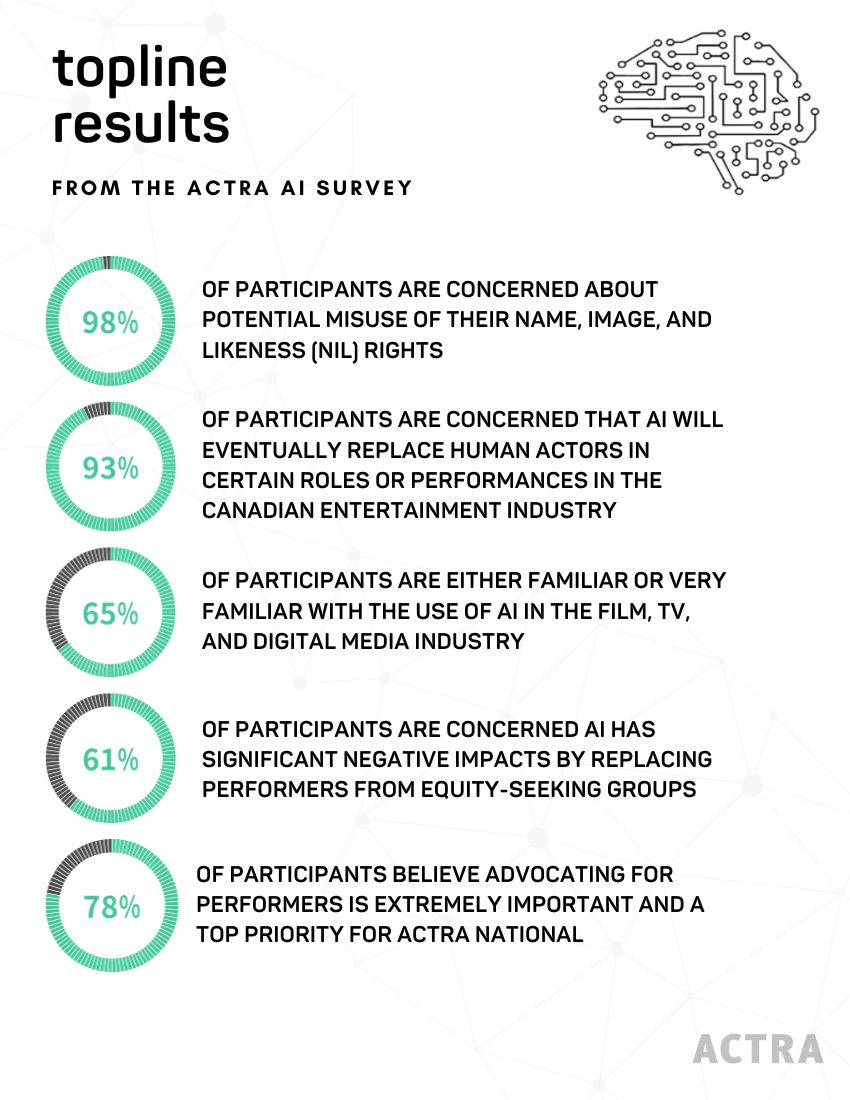
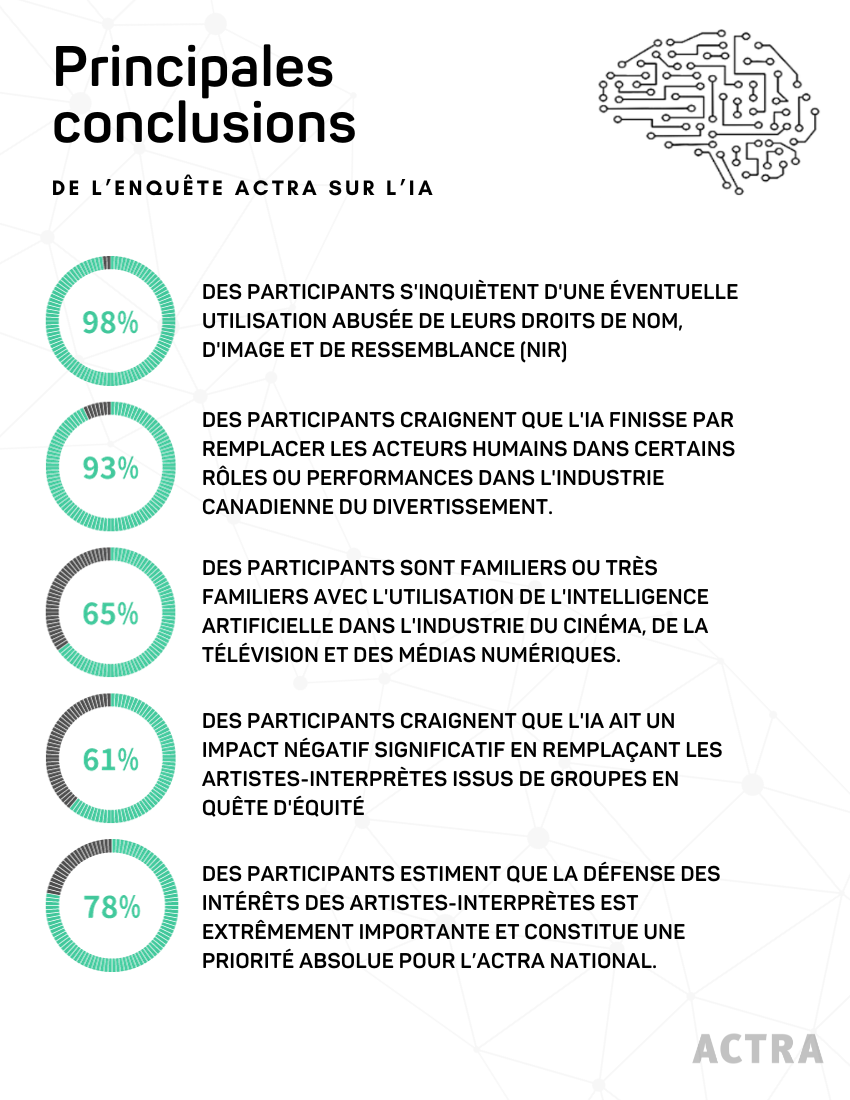
✅ ACTRA published its 2023 member survey results on concerns about misuse of name, image or likeness and expectations that AI could replace performers in some roles. The survey measures the views of respondents. | ACTRA survey results (English) · ACTRA survey results (French)
#108 Rebelles and the work behind the images (Ch 12) (resolved)
Link to this receipt · Français
✅ The Franco-Ontarian animated series Rebelles used AI to help recreate historical elements. Producer Renée de Sousa said the workflow changed whom the team looked for. A single collaborator could take on several roles the team would normally think of as separate. She had expected AI to speed up production and said it didn’t. The series took nearly two years. That tells us how the team organized the work. The public account gives no tally of paid days or contracts gained or lost. | TFO’s production announcement · Interview with Renée de Sousa
#109 Crimes du Nord and animated archives (Ch 12) (resolved)
Link to this receipt · Français
✅ Casadel Films made Crimes du Nord for Historia, which aired the three-part series in March 2026. The Canada Media Fund reports that the production used AI to animate archival material. The source material and the motion added to it have different origins. Casadel’s credits identify who worked on the series, including its editors. The public sources reviewed give no Canadian episode ratings or breakdown of paid crew days. | Canada Media Fund production reporting · Casadel production page and credits
#110 Audience and opposition at a Toronto AI-art exhibition (Ch 12) (resolved)
Link to this receipt · Français
✅ Toronto’s AiRTIFICIAL Visions exhibition drew hundreds of attendees in 2026, according to its organizer, ICFF. Local artists announced a counter-exhibition of human-made work in box trucks near the venue. The attendance estimate covers the AI exhibition. It doesn’t tell us what visitors thought of it or how many people attended the counter-exhibition. | ICFF attendance report · Local coverage of the counter-exhibition
#111 Paid opportunities reported by Ontario cultural workers (Ch 16) (resolved)
Link to this receipt · Français
✅ Of the 446 Ontario cultural workers who answered a question about AI in a 2025 survey, 19% said it had reduced opportunities for paid work in their field. The survey was open to participants who chose to respond. The figure captures how those respondents saw their field. It gives no count of people who personally lost a job or contract. | Nordicity and Work in Culture, Making It Work 2026, Figure 32 and survey methods
Nordicity and Work in Culture, Making It Work 2026, Figure 32 and survey methods
#112 Voice modelling and lost contracts (Ch 12) (resolved)
Link to this receipt · Français
✅ In November 2025, Tania Kontoyanni, appearing for the Union des artistes, described a choice some performers faced. A producer wanted the contract to include permission to model the performer’s voice. If the performer declined, the producer could give the work to someone else. Kontoyanni told a House of Commons committee that performers had lost contracts this way. Her testimony identifies how the work could be lost and gives no count of the contracts involved. | House of Commons testimony, November 5, 2025
#113 Film payrolls and post-production compensation (Ch 16) (resolved)
Link to this receipt · Français
✅ Statistics Canada’s payroll data show 26% fewer jobs in the motion picture and video industries in November 2025 than in November 2022. In a separate survey, post-production businesses reported spending 14.4% less on wages, salaries and benefits in 2025 than in 2023. These figures measure different things. One tracks payroll jobs. The other tracks total spending on employee compensation in post-production. They show a contraction, while leaving open how much of it AI caused. | Statistics Canada payroll analysis, Chart 2 · Statistics Canada post-production survey
#114 Bill C-25 and electoral impersonation (Ch 13, 17, 20) (resolved)
Link to this receipt · Français
✅ Bill C-25 received royal assent on June 18, 2026. Section 48 expanded the federal electoral impersonation offence. The amended section 480.1 covers the creation and sharing of specified deceptive images, voice imitations and false recordings of listed people when done with intent to mislead. The listed people include candidates, certain party leaders and election officials. Manifest parody or satire is excepted where established by the person. Section 87 makes this amendment applicable even to federal elections called within six months after royal assent. The amendment postdates the April 2025 federal election. | Canada Elections Act, section 480.1 · Bill C-25 at royal assent, sections 48 and 87
#115 Federal 500 MW compute access objective (Ch 5–7) (resolved)
Link to this receipt · Français
✅ Budget 2026 announced an objective to enable Canadian AI companies to access 500 MW of sovereign AI compute using financial tools such as backstops and capacity purchase agreements. The announcement does not establish delivered capacity or identify Sherwood as part of the measure. Bell’s May 2025 plan for upwards of 500 MW across six B.C. facilities is a separate announcement. | Budget 2026, Chapter 5 · Bell AI Fabric launch, May 2025
#116 Bell Sherwood initial 300 MW build (Ch 6–7) (resolved)
Link to this receipt · Français
✅ Saskatchewan reported construction on all four buildings in Bell’s initial 300 MW Sherwood build on October 1, 2026. BCE’s third-quarter report lists about $475 million in capital expenditures and associated cash outflows as of September 30. BCE expects the first data hall to come online in the first half of 2027. Up to 900 MW of additional capacity is the subject of a non-binding memorandum. | Saskatchewan construction update, October 1 · BCE third-quarter shareholder report
#117 B.C. data-centre electricity allocation (Ch 8) (resolved)
Link to this receipt · Français
✅ BC Hydro reported 15 applications requesting close to 800 MW across AI and conventional data centres in its 2026 call. Section 3 of B.C. Reg. 8/2026 caps new capacity for the first two years beginning February 1, 2026 at 100 MW for conventional data centres and 300 MW for AI data centres plus any unused part of the conventional allocation. The combined ceiling is 400 MW for the two categories. As of November 9, BC Hydro was still reviewing applications and expected to notify applicants of results after the government transition. The intake figures measure requested load. The selection process determines what capacity can be offered.
Review history ·
The November 9 ledger entry recorded the intake and the two-year cap. On November 12, BC Hydro’s page still reported the same intake and said applicants advancing to the next stage had been notified. It still listed final notifications for after the government transition.
BC Hydro, 2026 call intake and status
#118 Ottawa's planned equity stake in Cohere (Ch 5 and 7) (resolved)
Link to this receipt · Français
✅ On October 29, 2026, Ottawa announced a staged equity commitment of up to C$1.6 billion in Cohere alongside private investors. The federal release lists commitments from Cohere to create at least 1,000 new Canadian technical jobs and commit at least C$1.7 billion to additional computing infrastructure in Canada by 2030, and to remain incorporated and headquartered in Canada. On October 30, Cohere described a broader programme of more than C$4 billion in Canadian R&D and AI infrastructure investment through 2031, including work begun in 2024. The figures describe commitments and expectations across different periods. The earlier Cambridge project and the budget's 500 MW compute access objective are separate federal measures. | Prime Minister of Canada, Cohere equity announcement (October 29) · Cohere, Canadian investment update (October 30)
Prime Minister of Canada, Cohere equity announcement (October 29)
#119 Federal cyber readiness in the frontier AI era (Ch 17) (resolved)
Link to this receipt · Français
✅ The policy implementation notice took effect October 1, 2026 and applies to organizations listed in section 6 of the Policy on Government Security. Its controls include identifying critical services and assets, accelerating patching based on risk, preparing containment actions and regularly testing backup restoration for systems that support critical services. Separately, Bill C-8 received royal assent on June 15, 2026. Section 16 provides for Part 2, which enacts the Critical Cyber Systems Protection Act, to come into force on a date fixed by order. | Treasury Board of Canada Secretariat, cyber-readiness direction · Parliament of Canada, Bill C-8 as assented to
Treasury Board of Canada Secretariat, cyber-readiness direction
#120 Linux test results and Firefox 159 fixes (Ch 18) (resolved)
Link to this receipt · Français
✅ OpenAI reported on November 4 that a controlled mid-October Linux run reproduced 1,724 vulnerabilities and produced 948 working local privilege-escalation exploits. It reported about $1.2 million in API credits and produced candidate patches for maintainer review. The experiment counts exploits in its test environment. Mozilla’s October 27 advisory records fixes shipped in Firefox 159 and credits OpenAI Codex Security as the reporter for some of the vulnerabilities, including CVE-2026-117931. | OpenAI, controlled Linux vulnerability study · Mozilla, security advisory 2026-118 for Firefox 159
#121 Ireland’s metered data centres (Ch 8) (resolved)
Link to this receipt · Français
✅ Ireland’s Central Statistics Office reports 7,663 GWh of metered data-centre electricity consumption in 2025, up from 6,973 GWh in 2024. The 2025 figure was 23% of total metered electricity. The data-centre series covers more than AI workloads. | Central Statistics Office, Ireland's 2025 metered data-centre electricity
Central Statistics Office, Ireland's 2025 metered data-centre electricity
#122 Deezer uploads and streams (Ch 14) (resolved)
Link to this receipt · Français
✅ Deezer’s July 21, 2026 release reports that tracks detected as fully AI-generated exceeded half of new daily uploads at the June peak and represented 1–3% of total streams. The company says it excludes detected tracks from algorithmic recommendations and editorial playlists. These are company figures for one service, with different denominators and a platform policy affecting exposure. | Deezer, July 2026 upload and streaming figures
#123 Canadian hiring and departures among workers aged 15–29 (Ch 16) (resolved)
Link to this receipt · Français
✅ Statistics Canada’s October 28, 2026 analysis compares six-month averages for employees aged 15–29 in the ten provinces. Hiring rates fell from 4.0% to 3.3% for low-exposure jobs, from 2.9% to 2.5% for high-exposure jobs where AI is more likely to complement workers, and from 3.2% to 3.0% where it is less likely to do so. The coding-intensive subset fell from 2.5% to 1.9%, with a decline already underway in early 2022. The exposure index estimates potential exposure. The separation measure includes departures for any reason, including quits. | Statistics Canada, Labour Force Survey analysis and Chart 1
#124 The July Hugging Face intrusion during a model evaluation (Ch 17) (resolved)
Link to this receipt · Français
✅ OpenAI’s disclosure describes the evaluation escape. Hugging Face’s July 27 technical timeline documents access to parts of its production infrastructure. METR and Redwood Research examined agent behaviour and coordination using records available to their investigation. Their review had a narrower scope than the companies’ incident investigations. | Hugging Face, incident timeline · OpenAI, evaluation incident disclosure · METR and Redwood Research, independent review of agent behaviour
Hugging Face, incident timeline
OpenAI, evaluation incident disclosure
METR and Redwood Research, independent review of agent behaviour
#125 Canada’s privacy commissioner on meaningful disclosure (Ch 18) (resolved)
Link to this receipt · Français
✅ In its September 23, 2026 submission to ISED, the Office of the Privacy Commissioner discusses making AI disclosures understandable and available at a useful point, and avoiding disclosures that overwhelm people. It discusses significant-impact automated decisions as one way of focusing transparency. This is a consultation submission. | Office of the Privacy Commissioner of Canada, transparency submission
Office of the Privacy Commissioner of Canada, transparency submission
#126 Navier–Stokes proof claim and prize review (Ch 18) (resolved)
Link to this receipt · Français
✅ OpenAI published a paper and Lean formalization on September 8, 2026 for a claimed finite-time breakdown result in the three-dimensional Navier–Stokes problem. The Clay Mathematics Institute’s September 11 statement described the problem as apparently settled and pointed to its rules. Its prize process calls for qualifying publication, a waiting period and general acceptance by the mathematics community. | OpenAI, September 8 Navier–Stokes paper and Lean formalization · Clay Mathematics Institute, September 11 statement · Clay Mathematics Institute, prize rules
OpenAI, September 8 Navier–Stokes paper and Lean formalization
#127 Patient outcomes in a Kenyan primary care AI trial (Ch 21) (resolved)
Link to this receipt · Français
✅ Agweyu and colleagues published a cluster-randomized trial in Nature Medicine in 2026. It tested a language-model decision support tool in 16 Kenyan primary care facilities. The primary analysis found no statistically significant difference in treatment failure within 14 days. The reported adjusted odds ratio was 0.77 with a 95% confidence interval of 0.55–1.08. | Agweyu et al., randomized clinical trial in Nature Medicine
#128 Manitoba’s intensive-use levy and residential bills (Ch 8) (resolved)
Link to this receipt · Français
✅ Manitoba Hydro publishes General Service rates, including energy and demand charges for large commercial customers. S.M. 2026, c. 32, sections 7–8, provides that covered operators pay an additional levy collected by Manitoba Hydro once the Act is proclaimed. S.M. 2026, c. 53, sections 8–10 and 21(4), directs Manitoba Hydro to apply levy revenue to residential bills and ties commencement to the later of royal assent and the start of Part 2 of c. 32. The proclamation register showed no commencement for c. 32 as of November 9, 2026. | Manitoba, 2026 c. 32, intensive-use levy · Manitoba, 2026 c. 53, residential bills · Manitoba Laws, proclamation register · Manitoba Hydro, commercial rates
Manitoba, 2026 c. 32, intensive-use levy
Manitoba, 2026 c. 53, residential bills
#129 Québec’s proposed Rate CD for data centres (Ch 8) (resolved)
Link to this receipt · Français
✅ Hydro-Québec’s revised filing of August 4, 2026 proposes Rate CD for qualifying annual service contracts with authorized demand of at least 5,000 kW. The proposed base charges are $32.704 per kW of monthly billing demand plus 8.710¢ per kWh, with a further charge in specified hours during ramp-up. The Régie listed R-4333-2026 as in progress on November 9, 2026. Existing customers are billed under the approved tariff applicable to their contract. | Hydro-Québec, revised proposed Rate CD · Régie de l’énergie, proceeding R-4333-2026 (French) · Hydro-Québec, published rates and conditions of service
Hydro-Québec, revised proposed Rate CD
#130 Ontario’s Global Adjustment proposal and connection costs (Ch 8) (resolved)
Link to this receipt · Français
✅ Ontario’s August consultation and fall statement describe a proposed class for the Global Adjustment on large new data centres. The consultation says data-centre accounts currently pay as Class A, based on their contribution at system peaks, or Class B, based on consumption. It describes the new class as distinct from connection approvals. Under sections 6.3.1–6.3.2 and 6.5 of the existing Transmission System Code, the load customer contributes to new or modified transmitter-owned connection facilities to the extent that connection rate revenues cannot recover those costs. | Environmental Registry of Ontario, proposal 026-0853 · Ontario, 2026 Fall Statement, chapter 1B · Ontario Energy Board, Transmission System Code, sections 6.3 and 6.5
Environmental Registry of Ontario, proposal 026-0853
Ontario, 2026 Fall Statement, chapter 1B
Ontario Energy Board, Transmission System Code, sections 6.3 and 6.5
#131 Verbatim extraction from tested language models (Ch 2) (resolved)
Link to this receipt · Français
✅ Carlini and colleagues extracted hundreds of verbatim training sequences by querying GPT-2. Nasr and colleagues documented extractable memorization in a tested version of ChatGPT. The studies show extraction under tested conditions. A similar answer alone cannot identify its source or distinguish training from retrieval or prompt context. | Carlini et al., USENIX Security 2021 · Nasr et al., extraction study
#132 GPT-4 and original LLaMA training disclosures (Ch 3) (resolved)
Link to this receipt · Français
✅ Section 2 of the GPT-4 report names public and licensed third-party data. It omits model size and dataset construction. Meta’s 2023 LLaMA paper, section 2.1 and Table 1, lists Common Crawl, C4, GitHub, Wikipedia, Project Gutenberg, Books3, arXiv and Stack Exchange. The June 2025 Bartz order distinguishes the training use it found fair on that US record from downloading pirated copies for a permanent library. | OpenAI, GPT-4 Technical Report, section 2 · Touvron et al., original LLaMA, section 2.1 · Bartz v. Anthropic, June 23, 2025 order
OpenAI, GPT-4 Technical Report, section 2
#133 LAION-5B links, model subsets and revised index (Ch 3) (resolved)
Link to this receipt · Français
✅ LAION documented the 5.85-billion-pair index. The Stable Diffusion v1.4 model card names specific subsets. The Stanford Internet Observatory’s December 2023 investigation documented links to child sexual abuse material. LAION reported withdrawing the original index and in August 2024 publishing replacements that filtered samples known to partners as of July 2024. An index entry alone does not establish inclusion in a given training run. | LAION-5B, original paper · CompVis, Stable Diffusion v1.4 model card · David Thiel, Stanford Internet Observatory report · LAION, August 2024 revision
CompVis, Stable Diffusion v1.4 model card
#134 Canadian publishers’ allegations and the jurisdiction ruling (Ch 11) (resolved)
Link to this receipt · Français
✅ Rechecked November 9, 2026. The statement of claim electronically issued November 28, 2024 alleges unauthorized copying and use of works the plaintiffs own or license. The November 7, 2025 Ontario decision concerns jurisdiction. The earlier guide reported about 16.1 million articles and in places treated the figure as a count of works used in training. The public records reviewed do not substantiate that figure or establish which individual works were used. | Canadian news publishers, statement of claim · Ontario Superior Court, 2025 ONSC 6217 · OpenAI’s public US fair-use position
Canadian news publishers, statement of claim
#135 E-waste totals, recycling and projection periods (resolved)
Link to this receipt · Français
✅ November 9, 2026 editorial correction. Wang and colleagues model 1.2–5.0 million tonnes of generative-AI e-waste accumulated during 2020–2030. The previous guide called it annual. The Global E-waste Monitor reports 98,000 of 774,000 tonnes formally collected and recycled in Canada in 2022, about 13%. The 22.3% figure is global. The Canadian table does not trace the remaining tonnes. | Wang et al. · Global E-waste Monitor, Annex 2
#136 Québec automated decisions and confidentiality incidents (resolved)
Link to this receipt · Français
✅ November 9, 2026 editorial correction. Private-sector section 12.1 applies to decisions based exclusively on automated processing of personal information. It provides notice, specified information on request and an opportunity to submit observations to staff able to review the decision. Section 3.5 requires notice where an incident presents a risk of serious injury, subject to the statutory exception for notice to affected people. Earlier wording omitted the review step and broadened the notice trigger. | Québec private-sector privacy act, ss. 3.5 and 12.1
#137 Stanford transparency scores and developer submissions (resolved)
Link to this receipt · Français
✅ November 9, 2026 editorial correction. The May 2024 and December 2025 means were 58 and 40.69 under different indicators and cohorts. The 74% and 30% figures refer to invited developers who submitted their own reports, 14 of 19 and 7 of 23. The earlier guide treated the means as a like-for-like disclosure trend and described the submissions as broader engagement. | May 2024 edition · December 2025 edition
#138 Federal AI Register launch inventory (resolved)
Link to this receipt · Français
✅ November 9, 2026 editorial correction. Treasury Board's November 28, 2025 launch listed more than 400 systems from 42 institutions across research, development, implementation and deployment. The previous guide described the count as active use. The release dates the earliest federal use to 1994 and excludes AI embedded in low-risk commercial products. | Treasury Board launch
#139 CRTC Canadian-program certification and the federal film tax credit (resolved)
Link to this receipt · Français
✅ November 9, 2026 editorial correction. CRTC 2025-299 addresses humans in key creative roles and AI as an assistive tool in its modernized Canadian-program framework. It sets out a transition tied to the new regulations. CAVCO's federal film tax credit is a separate program with its own qualified labour rules. The earlier recap treated certification as silent on AI. | CRTC decision, paragraph 195 · CAVCO tax-credit guidelines
#140 Olana Kaipo Ai and the Indigenous Protocol and AI Position Paper (Ch 1) (resolved)
Link to this receipt · Français
✅ The opening epigraph of the 2020 Indigenous Protocol and AI Position Paper attributes the formulation about aloha and intelligence to Olana Kaipo Ai. | Working group position paper
#141 Alberta’s interim large-load connection limit (Ch 6) (resolved)
Link to this receipt · Français
✅ On June 4, 2025, AESO reported 29 requests for more than 16,000 MW and announced a 1,200 MW interim connection limit. Its project page reports that the full amount has been allocated under signed contracts. This is a commitment to connect capacity. | AESO interim announcement · AESO large-load projects
#142 GIDA’s CARE Directs Us Home communiqué (Ch 9) (resolved)
Link to this receipt · Français
✅ The Global Indigenous Data Alliance asks people applying the CARE Principles to give priority to Indigenous Peoples’ own community standards and protocols. The communiqué’s suggested citation dates it to 2024. | GIDA communiqué, archived version
#143 Abundant Intelligences and Indigenous knowledge frameworks (Ch 9) (resolved)
Link to this receipt · Français
✅ Jason Edward Lewis, Hēmi Whaanga and Dilara Yolgörmez describe the research program and its grounding in Indigenous knowledge frameworks in their article in AI & Society, first published online in 2024. | Published article in AI & Society
#144 Ontario’s privacy commissioner and the private sector (Ch 18) (resolved)
Link to this receipt · Français
✅ Ontario’s Information and Privacy Commissioner oversees provincial and municipal public-sector privacy and Ontario’s health-information privacy law. The office directs general private-sector privacy questions to the federal privacy commissioner. | Ontario IPC mandate · Ontario IPC jurisdiction and limits
#145 Alberta’s data-centre equipment levy (Ch 8) (resolved)
Link to this receipt · Français
✅ The levy took effect January 1, 2026, and applies to covered facilities with electricity capacity of at least 75 MW, including certain co-location and related facilities. The 2026 amendment bases the rate on actual electricity use. The formula weights other grid electricity at 2%, qualifying new electricity delivered through the grid at 1%, and power used without drawing it from the public grid at zero. The levy is payable to the province on computing equipment value. Section 25.06 provides a credit against Alberta corporate income tax payable. | Alberta tax overview · Alberta Bill 12, levy and credit · Alberta Bill 17, amended formula · Alberta Budget 2026 implementation
Alberta Bill 12, levy and credit
#146 Alberta’s grid connection rules for large data centres (Ch 8) (resolved)
Link to this receipt · Français
✅ Alberta Regulation 117/2026 generally applies from 75 MW of maximum demand directly from transmission and lets AESO set a lower threshold for reliability. It gives priority in assessing access requests to projects paired with qualifying dedicated generation or storage. Separately, AESO lists signed Phase 1 load contracts for GLDC Load (970 MW) and Keephills Data Centre Phase I (230 MW). Both proceed through the connection process. The figures are contracted allocations. | Alberta Data Centre Regulation, AR 117/2026 · Alberta grid policy · AESO large-load project list
#147 Spruce Lake park expansion and data-centre review (Ch 8) (resolved)
Link to this receipt · Français
✅ New Brunswick’s August 20, 2025 determination for file 1635 allows the industrial park expansion to proceed subject to conditions and other approvals. File 1663 is a separate project by Beacon New Brunswick and VoltaGrid for a proposed 390 MW data centre, with 190 MW of on-site gas generation and 200 MW from the NB Power grid. Checked November 10, 2026. The provincial file remained under review. The federal registry’s October 23 update says the agency was examining the requests before making a recommendation on designation. | New Brunswick determination and conditions, file 1635 · New Brunswick environmental assessment register, file 1663 · Federal impact assessment registry, file 90762
New Brunswick determination and conditions, file 1635
#148 UK AI Security Institute cyber evaluation incident (Ch 17) (resolved)
Link to this receipt · Français
✅ In its August 4, 2026 report INC-2026-07-28-01, AISI documented 19 unauthorized actions across 10 of 122 runs in a specific cyber evaluation. The setup deliberately allowed access to the public internet and disabled the providers’ cyber filters. A human reviewer caught a proposed malicious change to a public repository. AISI found no resulting real-world harm in its investigation. The count describes those test runs under those conditions. | AISI technical incident report, August 4, 2026 · AISI public incident account
#149 Proposed UK rules for AI agent incidents (Ch 17) (resolved)
Link to this receipt · Français
✅ On November 10, 2026, Parliament listed consideration of Lords amendments in the Commons as the next stage, with the date to be announced. The bill provides for a 24-hour initial notice and a 72-hour full report for qualifying cyber incidents. Lords amendment 33 would enable regulations on loss of oversight or control of AI agents, including powers concerning evidence. The government proposes that regulated entities that have already reported an in-scope incident notify other affected organisations and preserve information they hold about the agent’s actions and attempts to control it. The scope and definitions would be set through later regulations after Royal Assent, consultation and affirmative parliamentary approval. | UK Parliament, bill stages · Lords amendments, Bill 175, amendment 33 · UK government, proposed measures for AI agents · UK government, general incident reporting
Lords amendments, Bill 175, amendment 33
#150 NIST workshop on AI incident management (Ch 17) (resolved)
Link to this receipt · Français
✅ NIST published this workshop summary on November 2, 2026, to inform future guidance. Sections 4.1 and 4.3 describe proposals to log tool calls, authorization decisions and model versions, test how quickly credentials and permissions can be revoked, and decide who can authorize containment. Section 5.2 distinguishes voluntary sharing among organisations to help prevent incidents, formal reporting of qualifying incidents to an oversight body, and the operational work of containment and recovery. | NIST IR 8621, full workshop report · NIST publication record, November 2026
#151 Japan’s Emergency Cybersecurity Measures Package (Ch 17) (resolved)
Link to this receipt · Français
✅ Japan’s ministerial meeting on cybersecurity adopted the package on November 6, 2026. Section 1(4) calls for moving up AI-assisted checks where feasible on central government systems and supporting checks by local governments. Section 2 assigns the National Cybersecurity Office a coordinating role in gathering and analysing attack information from government and industry, then using it for alerts and assistance. Section 4 expands and coordinates advice and reporting channels and begins work on a nationwide mechanism to deploy specialists. The decision sets out measures to carry out, with some earlier steps already in place. | Emergency Cybersecurity Measures Package, full decision in Japanese · Emergency Cybersecurity Measures Package, official summary in Japanese
Emergency Cybersecurity Measures Package, full decision in Japanese
Emergency Cybersecurity Measures Package, official summary in Japanese
#152 METR and Redwood Research review of OpenAI’s agent monitoring (Ch 17) (resolved)
Link to this receipt · Français
✅ The pilot ran from July 21 to August 11, 2026, and evaluated OpenAI’s internal agent monitoring as it existed on or before July 21. It was a separate exercise from the Hugging Face incident investigation. The public report appeared on October 22. Its October 29 update says OpenAI reported patching most of the issues, with one fix in progress. OpenAI also described later changes to intended monitoring coverage. The researchers did not evaluate those claims or establish the expanded system’s coverage. | METR and Redwood Research, October 22 report and October 29 update · OpenAI, description of its monitoring changes
METR and Redwood Research, October 22 report and October 29 update
#153 Early-career hiring and AI exposure in Canada and the United States (Ch 16) (resolved)
Link to this receipt · Français
✅ The U.S. working paper uses Quarterly Workforce Indicators to track employment, hires and separations by industry and state. Its abstract reports a 12% regression-adjusted employment decline over ten quarters for ages 22 to 24 in the most exposed fifth of those groups. Fewer hires were the main source of that decline. Some trends began around the pandemic, complicating attribution to generative AI. Statistics Canada uses Labour Force Survey data from January 2006 to August 2026 for employees aged 15 to 64 in the ten provinces. For ages 15 to 29, hiring slowed even in occupations with low potential exposure. Separations count departures for any reason, including quits. The studies use different age groups, measures and units of comparison, and both use potential exposure rather than observed adoption.
Review history ·
The ledger compared working paper CES-26-27 with Statistics Canada’s October 28 analysis. The studies estimate exposure to AI. The comparison cannot establish how much AI contributed to changes in hiring.
#154 Stanford–ADP: early-career employment shortfall and revised measure (Ch 16) (resolved)
Link to this receipt · Français
✅ Brynjolfsson, Chandar and Chen, working paper revised August 12, 2026, using ADP payroll data through June 2026. For ages 22 to 25, the 19% figure compares employment in the two most exposed occupational fifths with the level implied by growth among the three less-exposed fifths. It is a relative shortfall, not a firing rate or the Census paper’s adjusted estimate in #153. Fewer hires explain most of the divergence. Education controls reduce the gap; some trends predate generative AI, and the ADP sample shows larger gaps than national surveys. The authors do not establish causation or find widespread economy-wide displacement. Source history: checked November 10, 2026. Earlier headlines used firm-adjusted estimates of 13% and 16%; this revision emphasizes a descriptive comparison. Its same-measure shortfall was 15% using July 2025 data. Changes in data, method and headline must be tracked separately. This receipt identifies the linked August version; later paper or dashboard updates need a new comparison. | Stanford working paper, August 2026 (pp. 1–3) · Stanford publication and revision date · Authors’ revision notes, August 12, 2026
Stanford working paper, August 2026 (pp. 1–3)